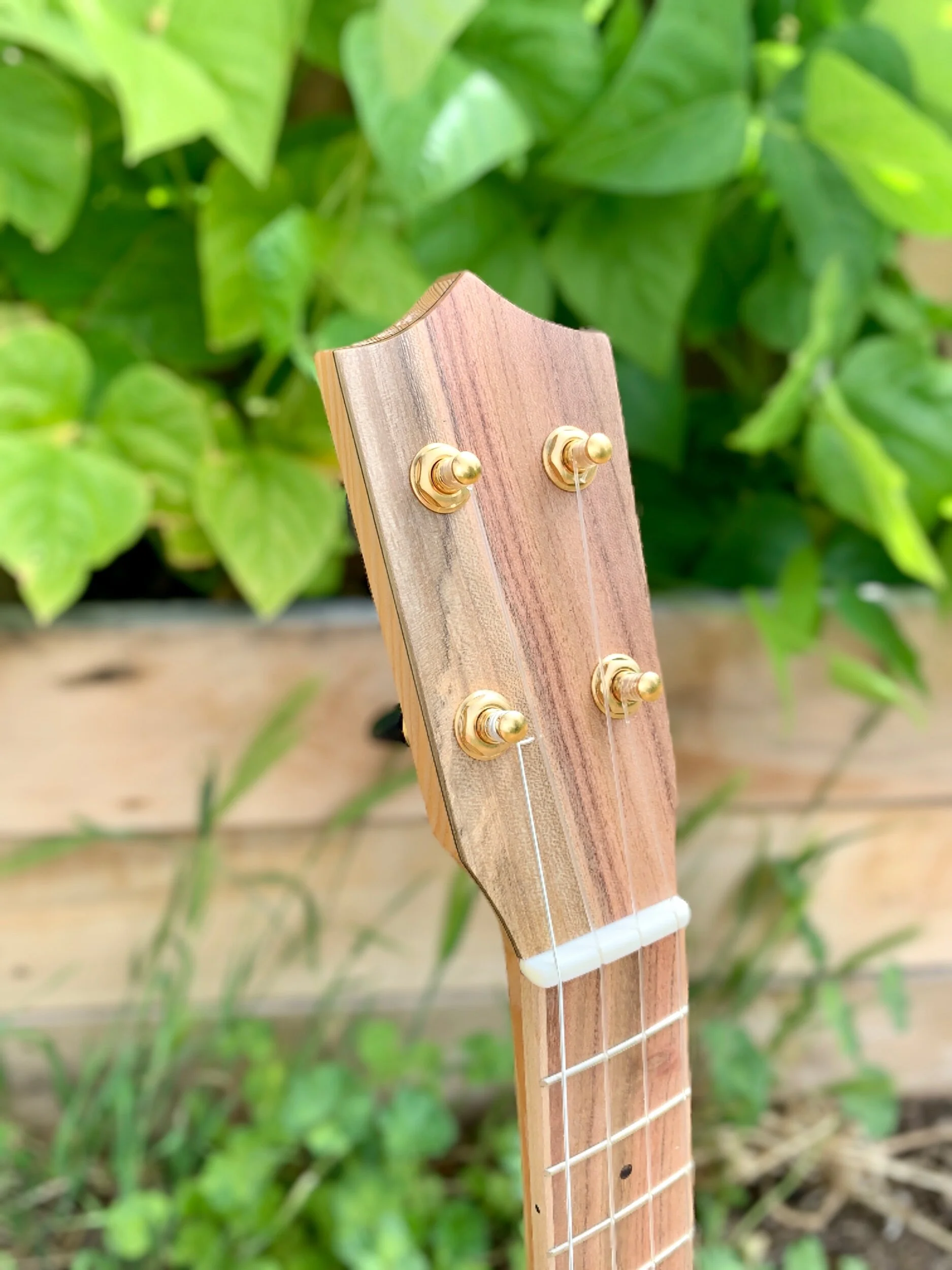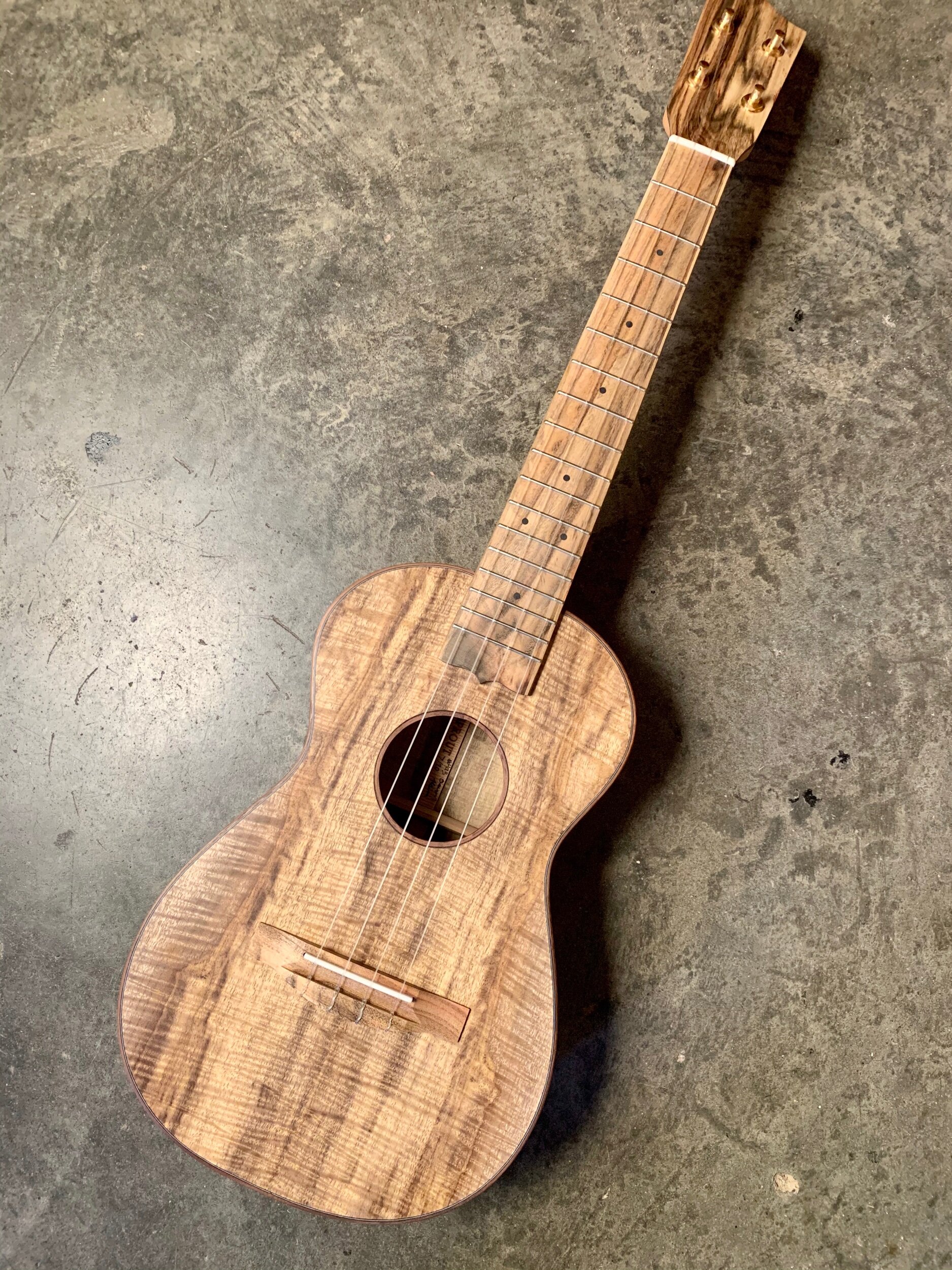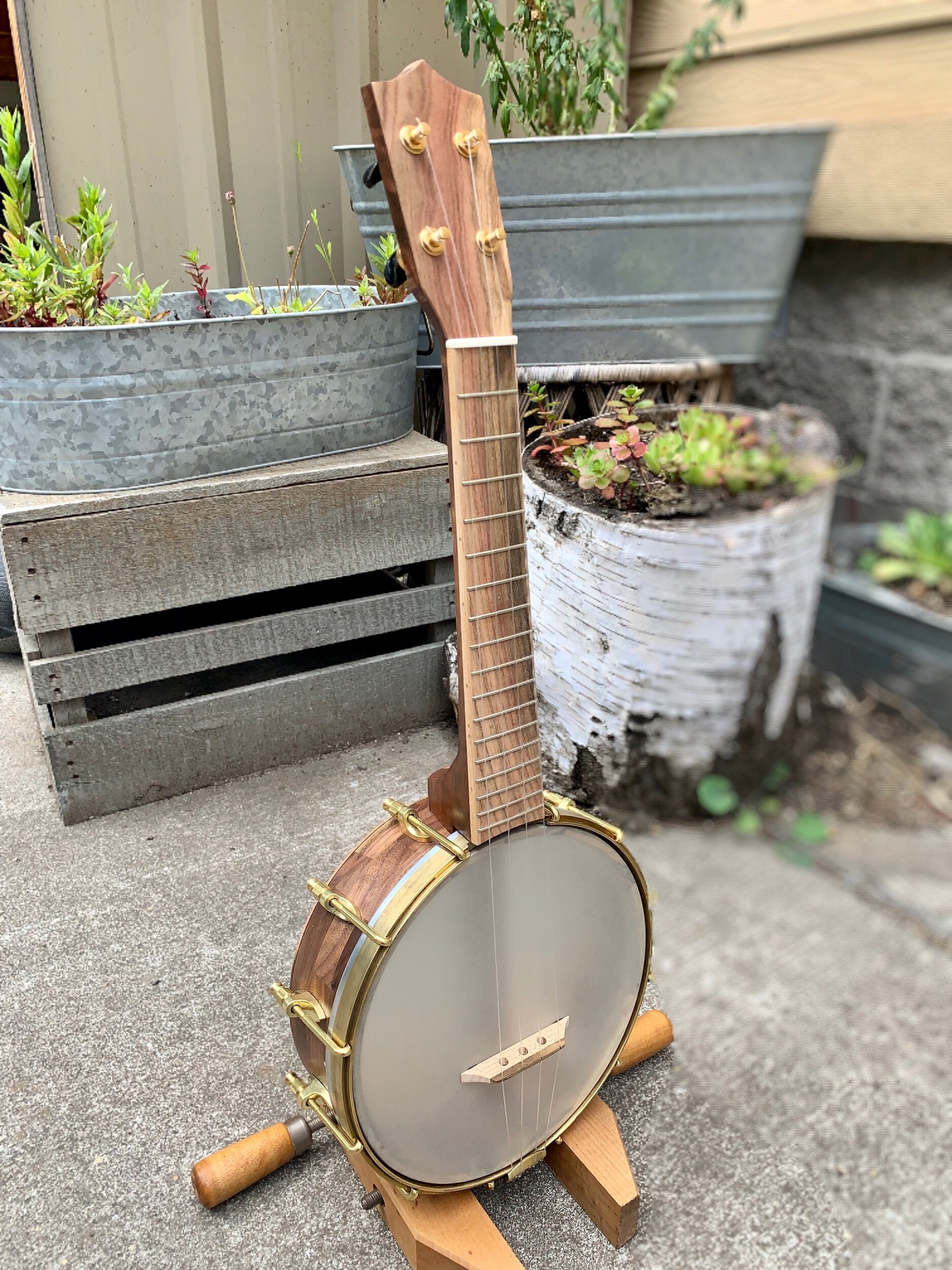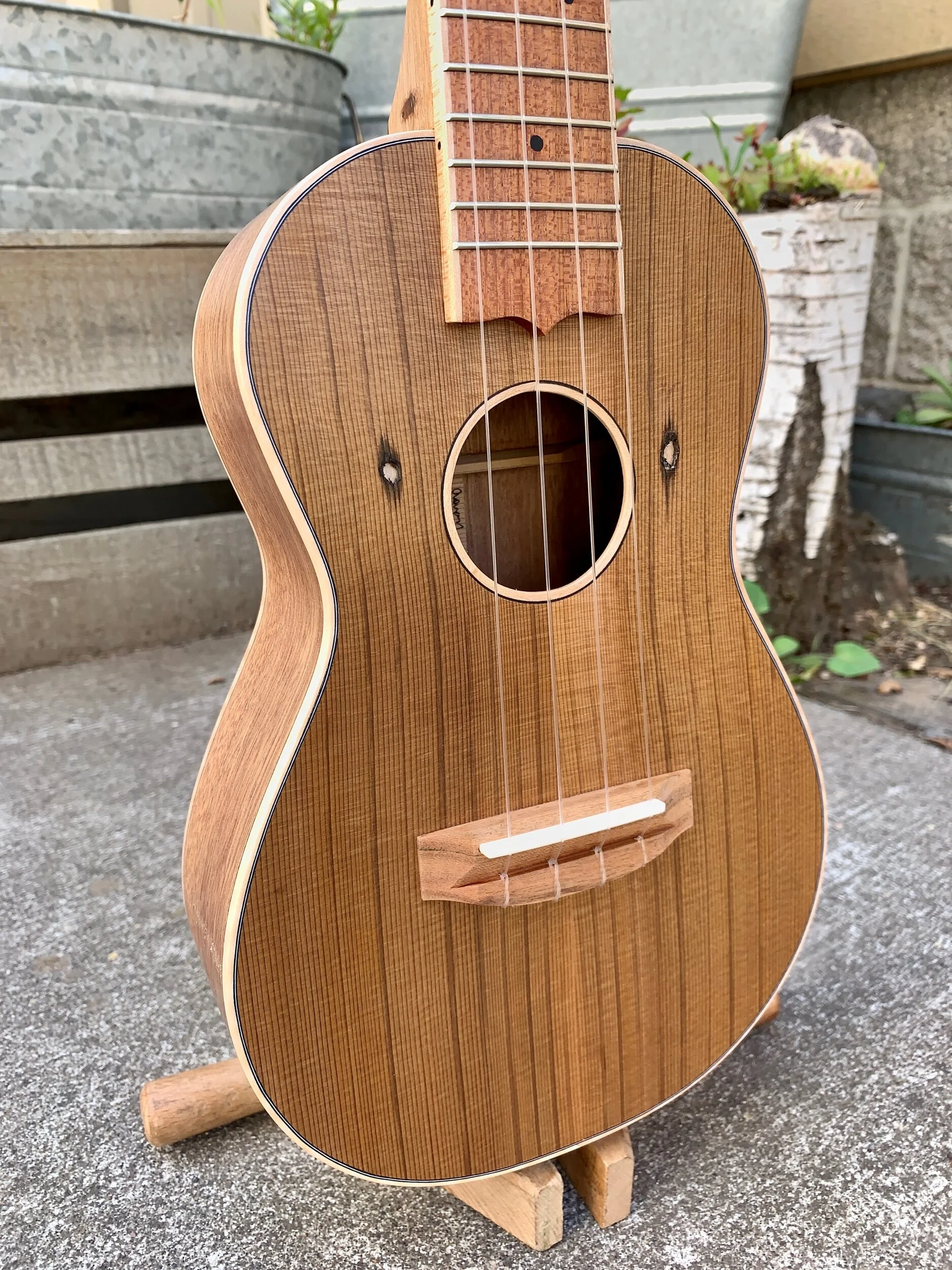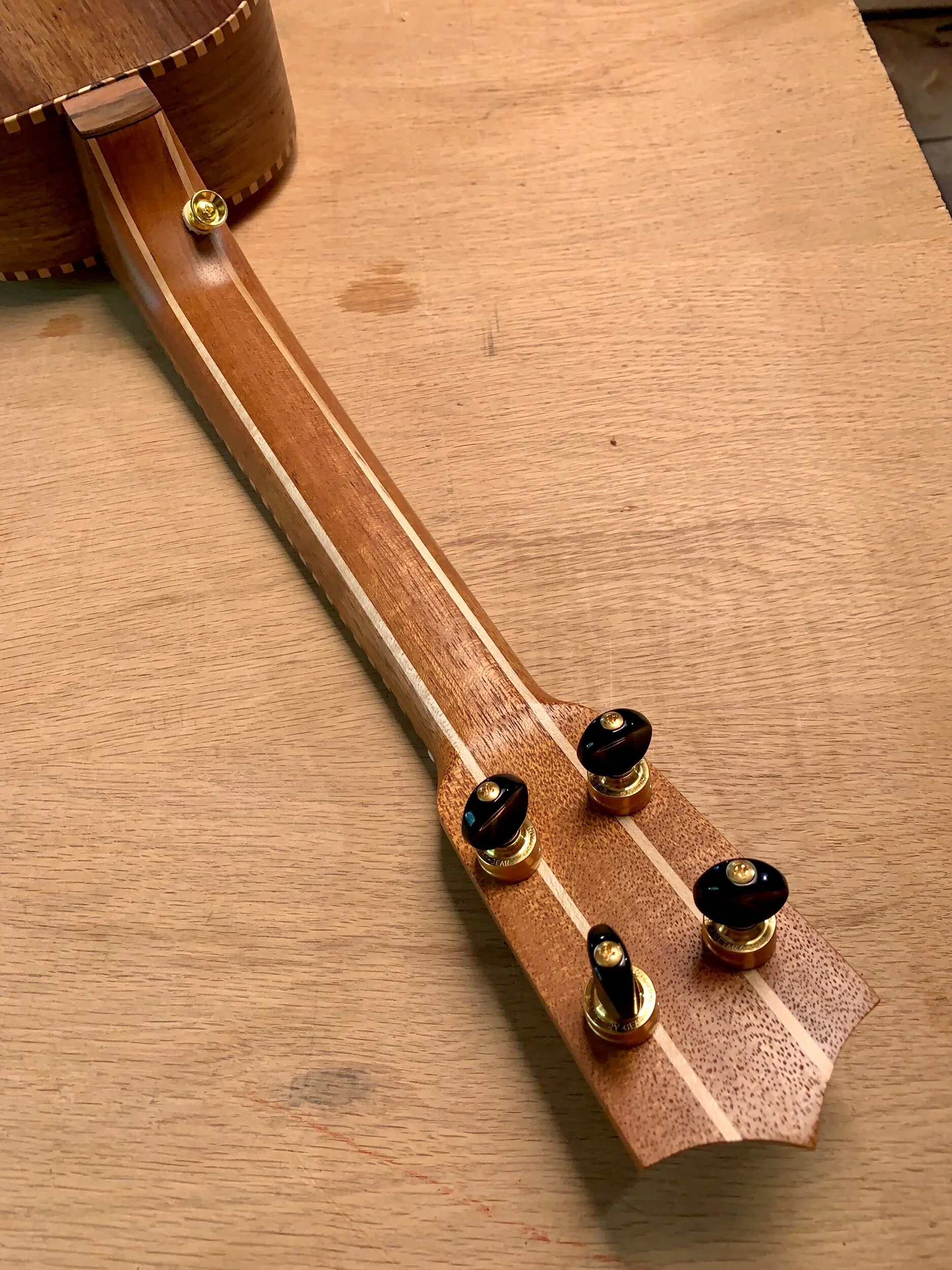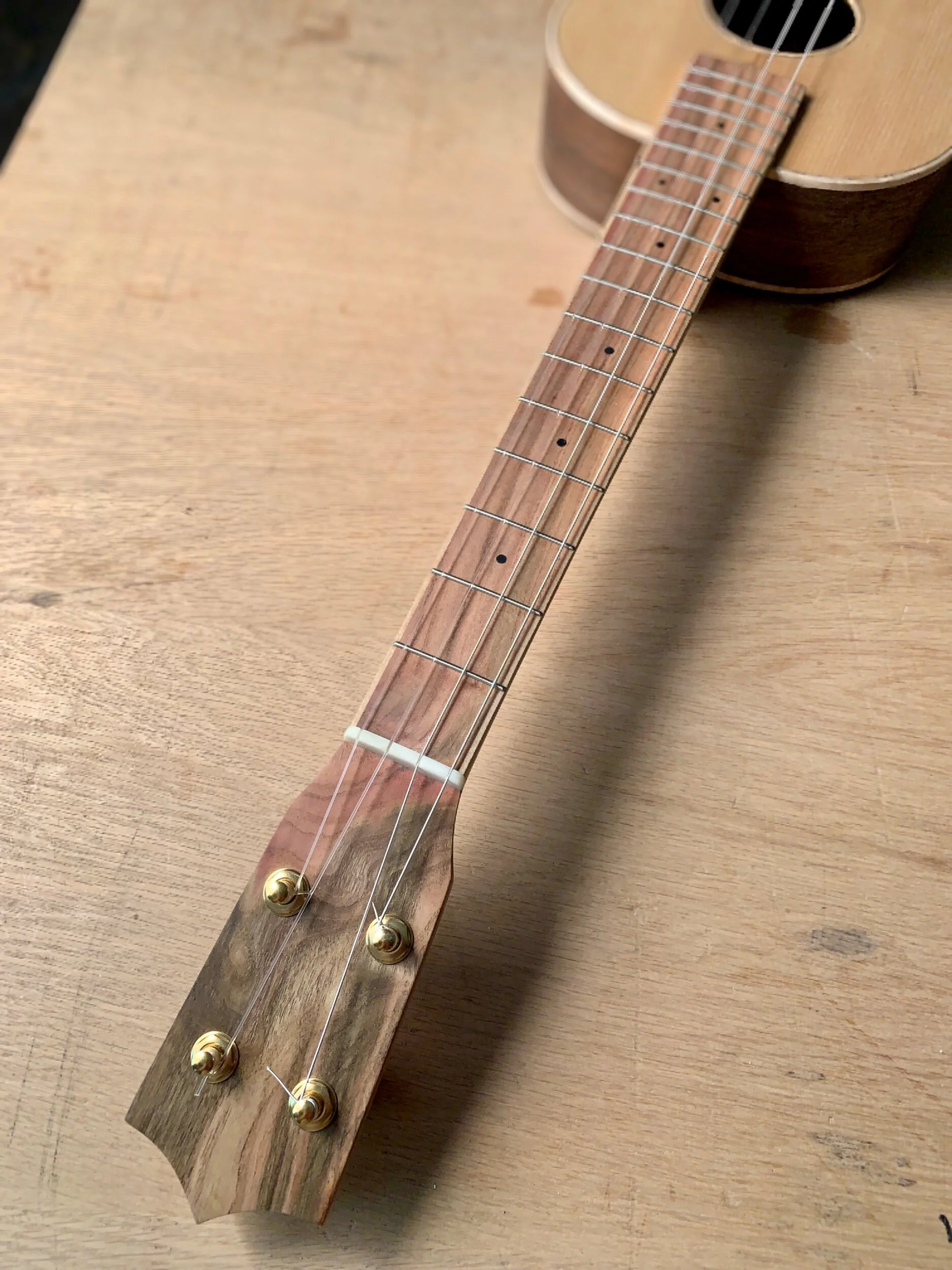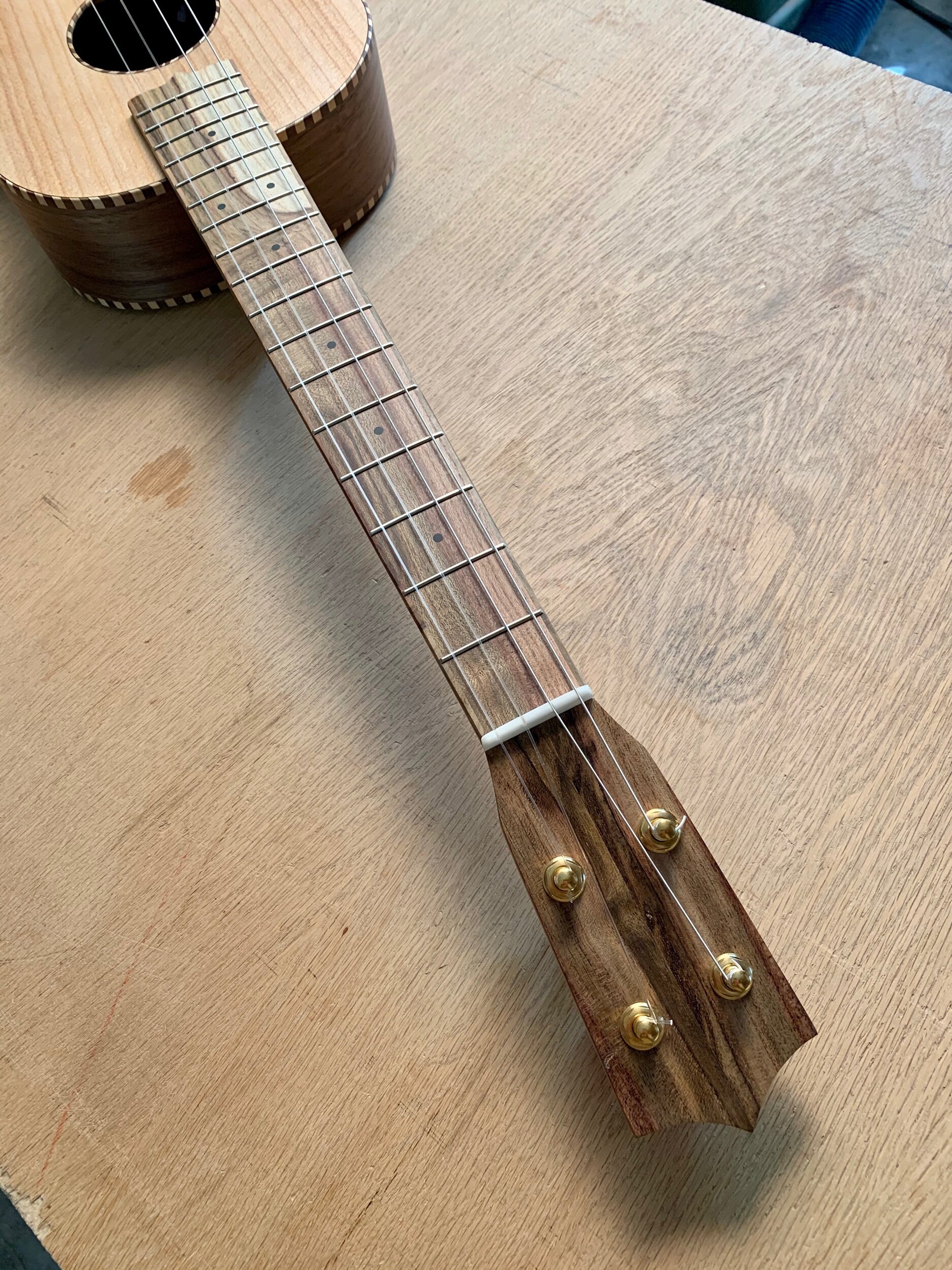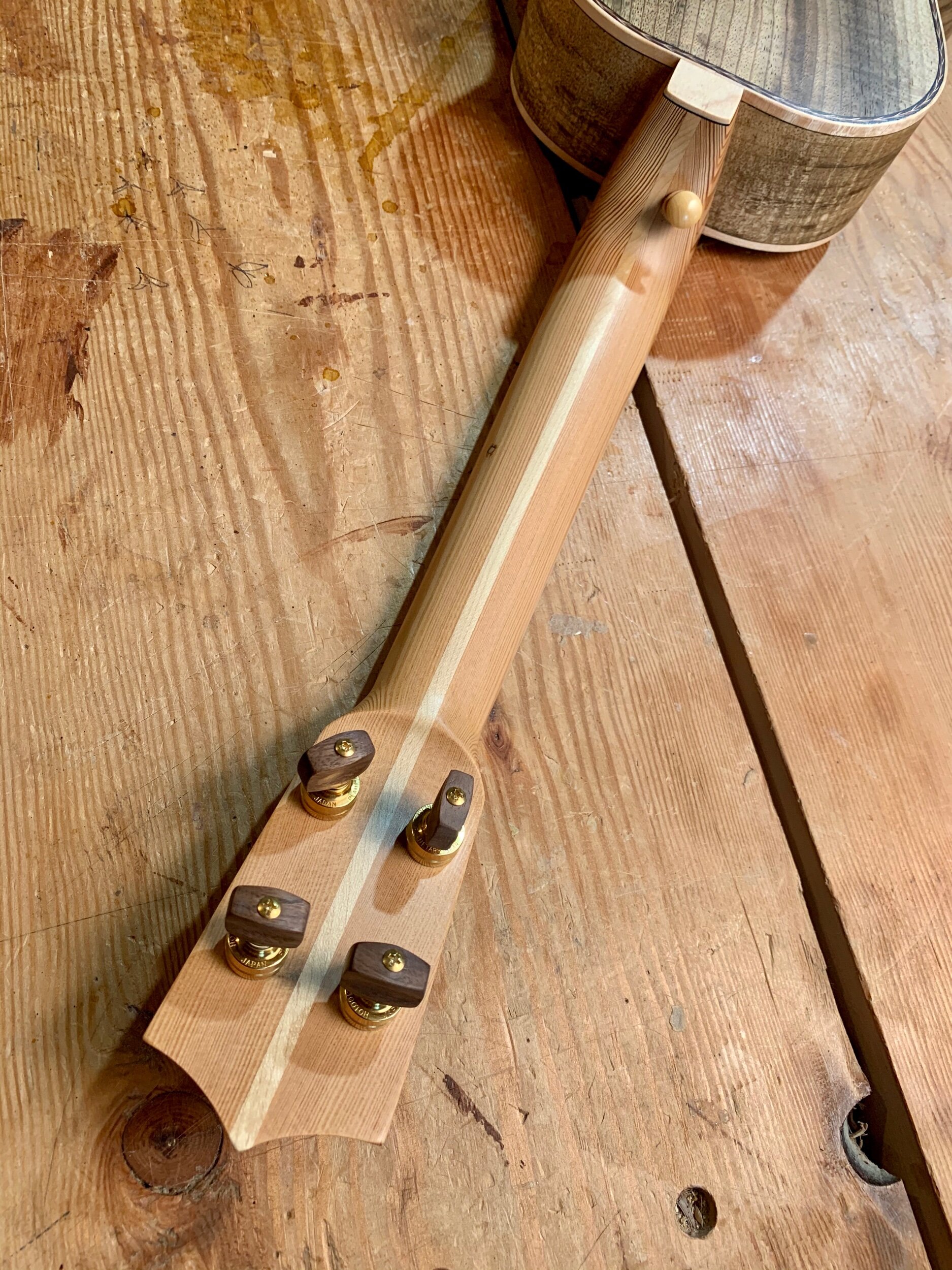
The Scout ukulele is one of my most satisfying projects. I make them following my own whims, using whatever wood I want on my own schedule. This one is for some local friends, artists and small businesses owners that we are lucky to have in our community. The Myrtle back and sides are the cut offs from two of my personal instruments. I saved the last of this extra dark Myrtle because I couldn’t bear to scrap it. It was just big enough for a scout ukulele. The neck is made from some salvaged mustard tanks and smells like vinegar when you sand it! For the fretboard, headplate and bridge I chose some straight grain maple from the scraps left over from building my workbench. All of these “scraps” come together to make a humble instrument that hopefully has some extra meaning on top of its functionality as a uke.
#493- Spruce and Pistachio Alto Ukulele
Pistachio is a rather dense hardwood, which makes it good for the back and sides of an instrument. But, you have to get the thickness right or the uke will be on the heavy side. I feel like I’ve finally got it dialed in! The combination with the spruce top makes for a lively sound with good projection and the low g adds surprising depth. The pistachio is from California Orchards, the spruce top was cut in 1960’s for a dulcimer builder and the fir neck is from an old floor joist.
“Thank you, Aaron, Nicole, and Henry!
This by far is the nicest work of art that I have ever strummed!!
A friend mentioned Roxy’s Waltz when I wanted to increase my skill and learn fingerstyle. She took a workshop with you, Aaron at Ashokan Uke Fest in 2019. I loved how the song was written out and it was the first fingerstyle song I learned. I looked up Aaron’s name, found the website, saw the books and purchased a bunch. I loved how they were printed out and the step by step methodology. I also loved the corresponding YouTube videos so I can play along. I love Henry’s cameo appearances in the videos too. After purchasing the books I saw the gallery of instruments and could see the same passion within the books were also in the beautiful Beansprout works of art. I love that Aaron uses sustainability practices repurposing the wood too. I love my Beansprout Ukulele. It sounds awesome! The first song I played on it was Roxy’s Waltz. (with shaking hands :) )
P.S. Thank you so much, Henry for the lucky chicken feather! It’s really cool!
Best,
R. H. ”
#495- Mastergrade Myrtle Tenor Ukulele
I call a Myrtle set “Mastergrade” when it has beautiful curl and amazing color variations and this set from woodfromthewest.com fits the bill. Myrtle grows in southern Oregon and Northern California and it is pretty rare to find a figured tree big enough to use for tonewood. For almost ten years now I have been making all Myrtle ukuleles and they never disappoint. The pistachio fretboard and headplate come from California orchards and the salvaged Douglas Fir neck (with a cool looking knot) comes from a salvaged floor joist.
#499- Walnut and Pistachio Mini Five String Banjo
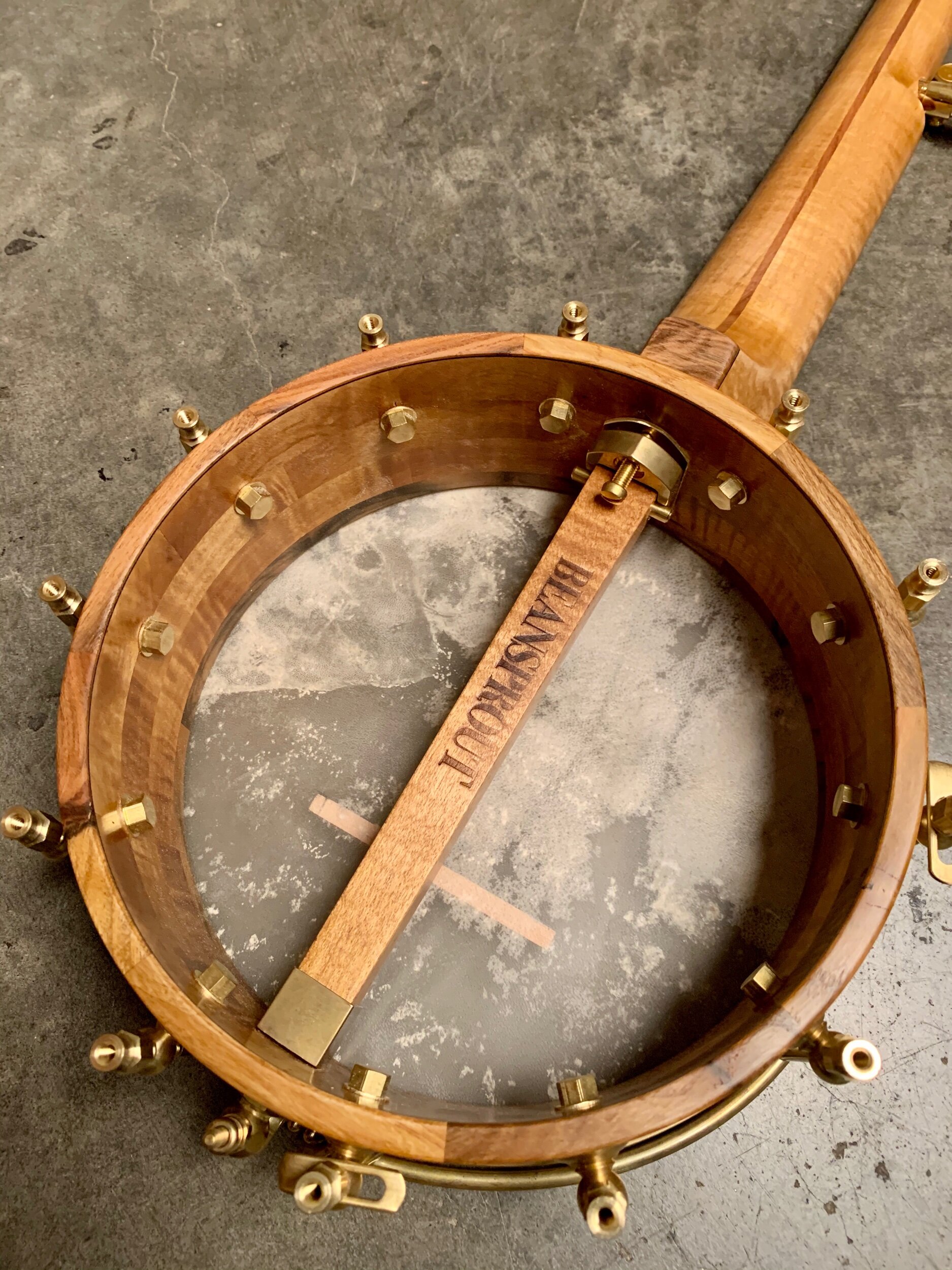
Dark, rich and vibrant. Like espresso mixed with whiskey. Or the smell of dirt after a good rain. Or mole sauce with a spicy finish. Sorry, I got distracted by this one. Straight grain walnut from the Carpenter Ant stash, pistachio from California orchards and an earthy goat skin head. It all adds up to a nice banjo which sounds great in open g and open a.
“I absolutely love the mini Banjo. I am new to the instrument but it’s so easy to play and has such a unique tone that I have hardly put it down since I received it. It has this low rumbly kind of sound that is exactly what I was hoping for and makes it seem like something that’s been making music for generations. Besides the Wife and the Dog, it’s the first thing I will grab if the house ever catches fire!
- J. P. ”
#492- Curly Port Orford Cedar and Curly Walnut Alto Ukulele
In some ways, this is a pretty standard ukulele for me, but it has a few features that make it stand out. The first is the fancy purfling from Gurian that we call “bird’s foot” purfling. It is the same as Nicole’s ukulele, which has been one of my my popular builds lately. The back and sides are cut from a Claro walnut gunstock blank, which is very beautiful and a obviously a little bit symbolic. These parts were so visually striking, that the rest of the wood is less flashy: a lightly curly Port Orford Cedar top, simple pistachio from California orchards and a hemlock neck salvaged from floor boards. Also, it plays easy and sounds great, happy strumming Harold!
“Dear Aaron and Nicole,
My Beansprout Alto arrived the other day safe and sound. It was awesome to see the finished ukulele when you posted it in your gallery, but was absolutely beautiful when I first opened the case and held it in my hands. It spoke to me and said, “I’m home”. It is easy to play and the tone, sound, and sustain are amazing. Aaron, you are a true craftsman and artist. Thank you for sharing your wonderful talent.
Thanks again,
H.H.”
#488- Bearclaw Spruce and Bird’s Eye Maple Alto Ukulele
Plain maple sounds as good as fancy maple, but it sure is fun to use this amazing set for this ukulele. The Bird’s eye maple was cut for ukuleles by Ken from the Carpenter Ant stash and I got to put it to use. The customer wanted a loud uke and she got it, but it’s also sweet with good sustain. The blond look is offset by small black lines and accents, which helps give the aesthetic some framing. The Bearclaw spruce is old growth salvaged from Alaska, the spruce neck is from Camp Westwind on the Oregon coast and the maple for fretboard and headplate are scraps from making my workbench.
“Just wanted to let you know my uke arrived safe and sound. It is a beauty and loud, just as you said. The “blond” look is awesome, glad I let you take the lead on that. The birds eye maple is to die for. I had a bit of a learning curve as I never had a radiused fretboard before. Thank you for continuing to use repurposed and sustainable woods in your building practices. I also love the alto size. It is perfect for me. This uke will be treasured for many years to come.
Thanks again,
G.H.”
#494- Curly Walnut and Pistachio Concert Banjo Ukulele
This was a fun instrument to put together, as it is a pretty standard model but with some small variations. The first was that Nancy wanted one of my “mosaic” rims, which are made from scrap pieces from neck blanks. It takes me most of a year to piece together enough material for a rim like this. I lay out the segments so it has a random appearance, with bits of neck laminations popping up after turning on the lathe. I had some amazing curly walnut for the neck, which needed a wider maple stripe to make a full neck blank. I visually supported this maple stripe by using maple fretboard binding. She also wanted brass fret markers, which are a little harder to see but very classy. The pistachio is from California orchards and the walnut is from Goby and the Carpenter Ant stash in Portland.
“I want you to know how much I’m loving my banjo uke. When I pick it up I wonder whether the people who own the ukes where those mosaic blocks came from are making wonderful music with their instruments too. My instrument feels like it’s part of a constellation of over a dozen other instruments. It’s very special to have. Thank you for that!!
- N. H.
(The quilt in the picture is one made by my ancestors - passed down from my Grandmother to my Mom, but no one knew exactly who made it. It shows evidence that it was well used. It also shows that scraps from several projects can be combined to form a beautiful, useful object that brings joy to others. My banjo and this quilt have that in common.)
”
#489- Cedar and Mahogany Alto Ukulele
This instrument is part of a project I have going with Tyde Music from Lake Tahoe, CA. We each sent each other a box of wood and are making ukes from each other’s stash. This alto is made entirely from salvaged wood: mahogany from a dock, cedar from a fence post and jatoba from a furniture project. I kept several nail holes, of course. I have to admit, this project has gotten me excited about cedar tops again. They are soft, but sound so good! If you are a hard strummer you may want to place a pickguard on it. I also am excited about the jatoba fretboard. Also called Brazilian cherry, it’s commonly imported for furniture and cabinets. I wouldn’t import it myself for ecological reasons, but to find it from a salvaged source I would use it. Stay tuned to see a second instrument I have coming for this project and to see what Tyde music is working on too.
#491- Curly Myrtle Scout Ukulele
Due to a couple of cancellations due to COVID-19, I’ve had the time recently to make a couple of these little Scout ukuleles. They are a fun challenge in that I intend them as humble folk art, but the perfectionist side of me is always pushing for higher quality. It’s a nice challenge. This one is made from curly Myrtle from the scrap bin from when I worked at Mya-Moe, pistachio from California orchards and Douglas fir floor boards.
“Dear Aaron and Nicole-
I’ve enjoyed getting acquainted with this little scout since its arrival. Having always favored soprano ukes, the addition of one of these to my collection was a no brainer. It is not only beautiful, but an absolute joy to play! At a glance one can truly appreciate the creative compassion that goes into each and every Beansprout build. While your craftsmanship goes without saying, I’ve also learned a ton from your music and video tutorials over the years. Thanks for ALL you do! Enclosed is a little sampling of my humble attempt at clawhammer.
Cheers!
- J.K.”
#483- Maple and Mahogany Five String Banjo
This instrument is a copy of the banjo I built for myself, #463. It was designed to be a lightweight, vibrant, thrifty banjo, made with wood on hand. The dark stain ties it all together and will make for a nice patina as it is played and shows its use. The rim is maple and the neck is mahogany and maple, all from the Carpenter Ant stash in Portland. It weighs in at 4lbs 2oz, has a lively sound and I like the old time folk art look. I like this design and am thinking of applying it to other banjo models I make.
“Hey Aaron - the Banjo arrived today in one piece :-) it looks great. I love how the fret board looks - especially the scoop. (Like tiger stripes) The pictures you posted does not do it justice. Way lighter and more comfortable than the banjo I currently have.
Thanks again.
- P. T. ”
#485- Spruce and Walnut Tenor Ukulele
If I needed to make one model that I thought could do it all, I think a spruce and walnut tenor might be it. Loud and sweet with good depth and sustain. Set with easy action and playability, it is ready to gig. I loved picking beautiful but simple materials for this one too: both the spruce top and walnut back sides were cut from one long piece to “force” a pseudo book match. It’s a thrifty way to use wood and makes for a subtle asymmetry that I like. The walnut is an orphaned wall panel from Goby in Portland and the spruce is old growth Sitka cut for dulcimers in the 1960’s. The pistachio is from California orchards and the mahogany neck is from the Carpenter ant stash.
“Dear Aaron and Nicole,
Thank you for this wonderful instrument! Arrived safe and sound in Hungary today. It is amazingly resonant and I really love the wood selection and that each part has a story.
Wish you all the best!
- Z. S. ”
#486- Port Orford Cedar and Curly Maple Alto Ukulele
This one hits all the marks for the Beansprout vibe: crazy figured wood paired with other humble materials, salvaged, repurposed and sustainable sourcing, easy playability and great tone. Don’t forget the single nail hole to keep us humble. The curly/spalted/quilted maple back and sides came from Char from Mya-Moe. She often saved pieces like this for me as she knew I was pretty adventurous. The pistachio fretboard, headplate and bridge feature some nice sapwood and are from California orchards. The old growth fir neck is from a floor joist. The simple walnut binding adds a nice contrast and ties it all together.
#484- Curly Maple and Pistachio Mini Five String Banjo
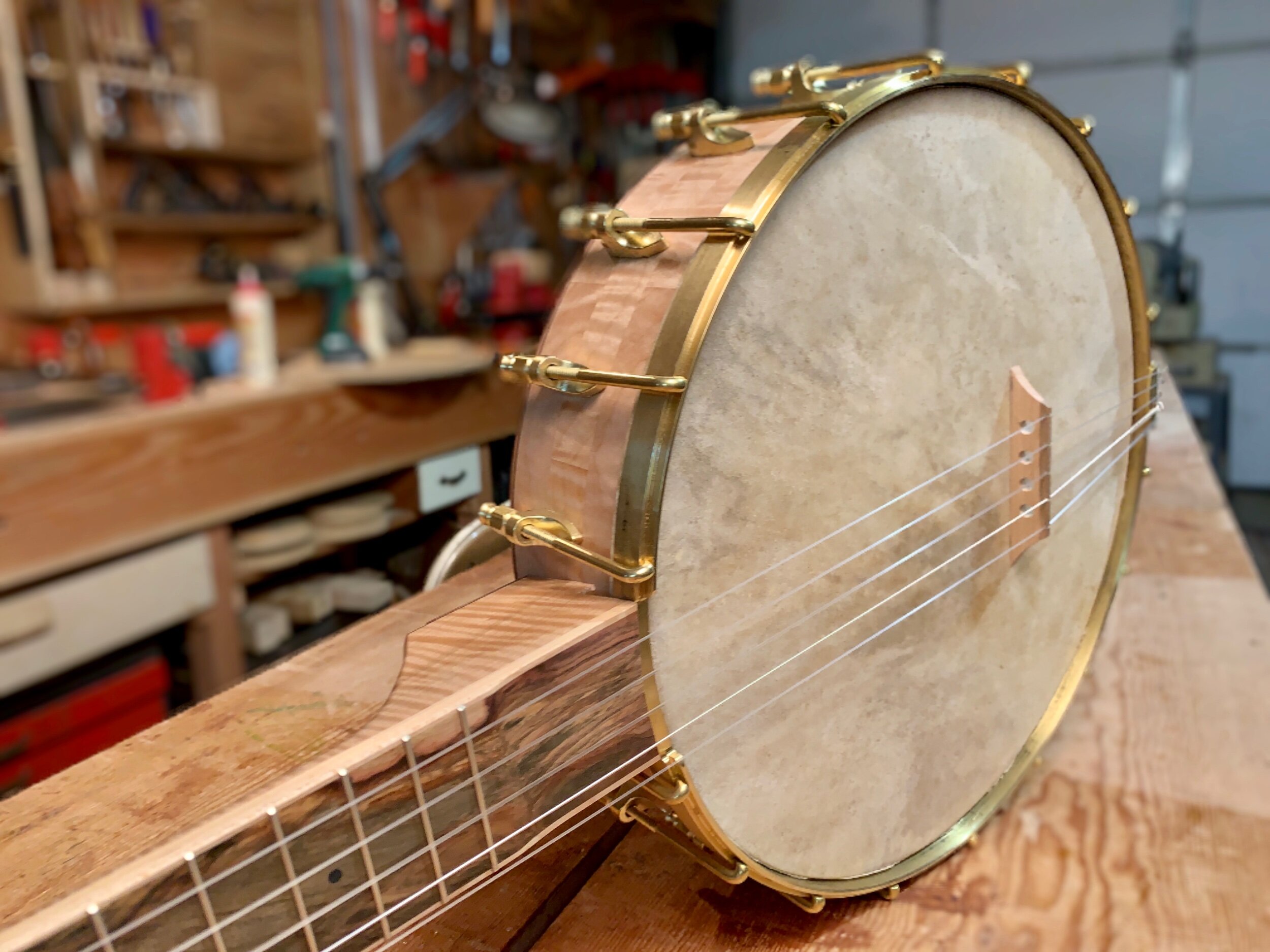
When I designed this instrument, I really though that most people would want it tuned in open c, a high tuning that matches its smaller size. But, its been far more poplar in open g, standard banjo tuning, with heavier strings. It really has found a place amongst people who need a smaller or lighter banjo because of physical issues in particular. Yes, the small size can’t produce the same volume as a big banjo, but it is a beautiful and rich tone that does cut through the mix. This one features amber stained curly maple from the Carpenter Ant stash, ball shoes, a brass arm rest, a goat skin head and pistachio from California orchards.
“I have received the banjo. It is beautiful to look at and a joy to play! Thank you.
- G. C. ”
#487- Spruce and Maple Scout Ukulele
As you may imagine, I often think about shop work in musical terms. It has a rhythm to it, with repetitive yet enjoyable tasks aligning to make a beautiful product. Some days I feel like a composer in the shop, other days a jazz musician, sometimes a conductor, other days a copyist. For this instrument, I started with the quilted maple back and sides and let it lead me, piece by piece, to all the other woods that would complete it. Improvisation is not “faking it,” it is the task of drawing from years of training and experience to create something new, within an agreed upon framework. In this case, the customer wanted a scout ukulele and the rest was up to me. After I chose the back and sides, I added the Oregon spruce top from Camp Westwind and a neck from Douglas fir floorboards. The fretboard and headplate are a scrap from making my own work bench and come from salvaged beams from the Carpenter Ant stash. All these light colored woods needed some contrast, so it is wrapped up in black walnut trim. As I put it in the case after snapping these photos, it feels like putting away a song, but the best part is that it has its own songs to sing when the case is opened again.
#476- Curly Maple and Pistachio Five String Banjo
I have more banjo orders coming up than normal this year, so I was feeling the need to dial in the process more and make some new jigs and fixtures. This banjo helped tweak and develop the process, which will hopefully lead to more accuracy and efficiency. The combination of a maple block rim, a skin head and non-steel strings make for a cheerful sound that I really like. It’s got plenty of volume, but is still sweet and not over powering. The amazing curly maple for this was from Zena forest products in Salem, OR. The pistachio is from California orchards.
“My new banjo, Annie, has arrived! It is absolutely gorgeous. We have been bonding this afternoon. I am beginning to get used to the non-steel strings, and with the goat skin head, the tone is nice and “plunky”. It has enough volume for playing on the back porch while not upsetting the neighbors. I am blessed to own such a beautiful, one of a kind instrument. Thank you!
[One Week Update]:
Hey Aaron,
I had to let you know... after playing for a week now, I am absolutely in love 🥰 with my banjo - exactly the way you made it. It is absolutely perfect in every way. Thank you! 🪕
-C. M. ”
#490- Curly Walnut and Pistachio Tenor Banjo Ukulele
Nicole and I have spent a lot of time thinking and feeling lately about how the world can be better. Some of our ideas are short term and immediate and some are long term and more subtle. One of the best things I think we can do is continue to produce long lasting objects of functional art; artistic tools that can outlast the current problems and be ready to pitch in for the next crisis as well. This banjo also has the bonus that the music that it makes has the potential to brighten spirits, change minds and at least produce beautiful music. So, here it is. Ready for whatever. Curly Oregon walnut from a retiring furniture maker, pistachio from California orchards.
#482- Spruce and Walnut Baritone Ukulele
Lately I’ve been interested in art that is humble by design. Simple things that function well and look tidy. I find that a humble design leaves room for your eye and hand to work harder to find the nuances. I went about choosing materials for this build with this in mind. Walnut wall panels for the back and sides, old growth dulcimer spruce for the top, pistachio from California orchards and an old growth fir floor joist for the neck. The curly maple binding wraps it up well, I think. This goes to an old friend who I know will use it well.
“Aaron and Nicole,
My baritone uke was delivered just a bit ago. You know, you are making me tear up again, first when I opened the case and lifted it out and held my new instrument, then several more when I strummed it and played a few notes. I know this is an overused word, but it is simply amazing. I was impressed just watching the video, but seeing, holding and playing it, it blows me away. You are right, it does vibrate, I love it!
Thanks again, I will have fun this weekend getting to know my baritone. Have a good weekend!
- J. B. ”
#481- Spruce and Walnut Baritone Ukulele
This instrument is for a fellow upright bass player! Even though I built it the same for him as I would anyone else, maybe the kinship comes through somehow. The wide grain Oregon spruce top (from Camp Westwind) defies all traditional logic. Despite it’s fast growth and wide grain, it is very stiff, allowing me to thin it down to where it sounds incredible but remains stable. It also has a lot of visual character, which ukulele customers appreciate more than other customers, I think. The curly walnut back and sides comes from the scrap bin at Goby and is a perfect foil for the spruce top. The grafted pistachio fretboard, headplate and bridge come from California orchards and the fir neck is from and old floor joist.
“Hi Nicole and Aaron,
I’m really loving the new uke! My previous baritone is an old no-name mahogany so this is an upgrade in every way. I like that it’s comfortable to play in the higher registers and the curve at the neck heel is perfect for quickly finding the 10th fret C. If I want to strum loudly I can rest my arm on the body to get some “compression,” but lift my arm off for more dynamic range when fingerpicking. The neck is really comfortable and I like the thick fretboard, just looks amazing. Thank you so much for your dedication to your craft. I had never played a Beansprout before but I knew if it sounded that good over the internet then it must be special. Right on!
Attached is a picture of me with uke. Best of luck for the future!
- J. M. ”
#480- Mastergrade Myrtle Tenor Ukulele- Nicole Signature Model
This was a special opportunity given to us by a long term customer. He asked for me to build an instrument as close as possible to Nicole’s ukulele, #444, including some of the same special handmade details. When I re-sawed the board for her ukulele, I worked hard to get four slices, which allowed me to make a close copy. The most dramatic part of this build is the one piece top and back with the swooping, angled grain. It has hand carved walnut tuning knobs, wooden fret markers, special purfling, wooden strap buttons, curly maple binding and a bird’s eye maple bridge. We feel lucky and honored to have the support of customers like this, who really appreciate the extra work it takes to make a special uke. The Myrtle is from a roadside stand on the Oregon coast, the fir neck is from an old floor board and the walnut and maple are from the Carpenter ant stash in Portland.
#475- Myrtle Scout Ukulele
Myrtle from the scrap bin, walnut from old wall panels, Douglas fir floorboard neck. My design based on the old Washburn Camp Ukulele. Soprano scale, flat fretboard, geared tuners, brass strap buttons, fluorocarbon strings, gig bag included. A charming musical companion, handmade and unique!