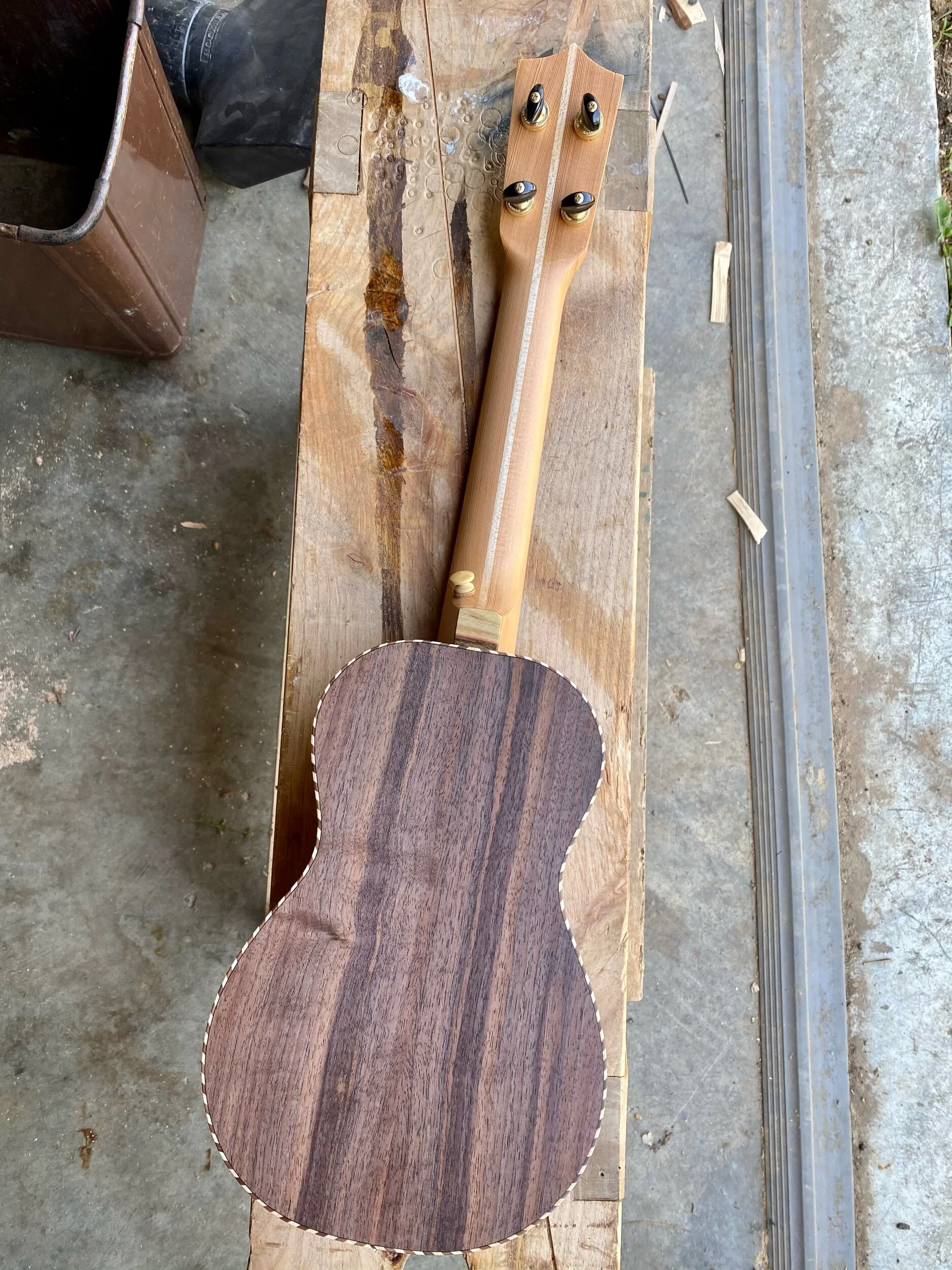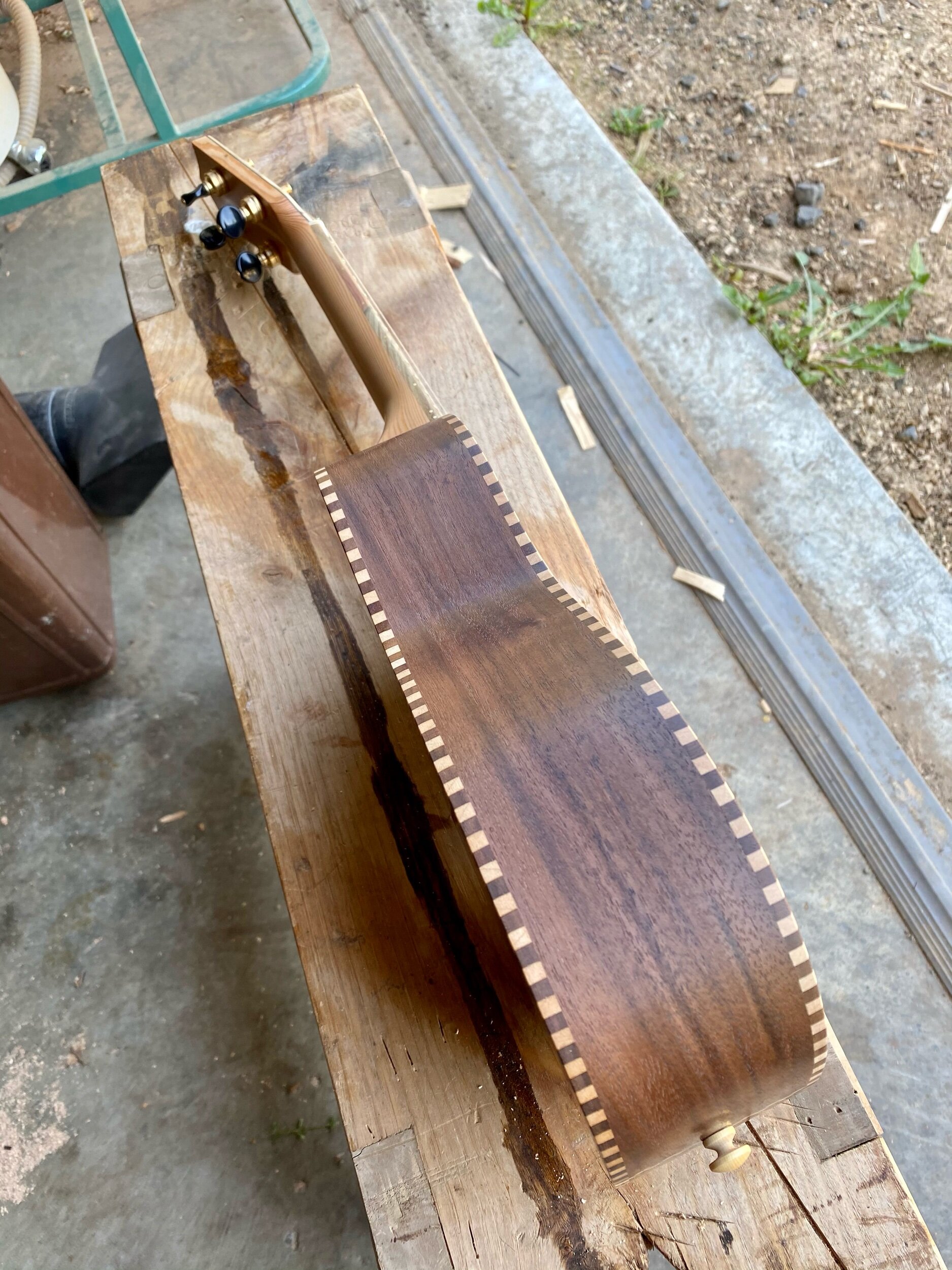
#594- Port Orford Cedar and Walnut Alto Ukulele

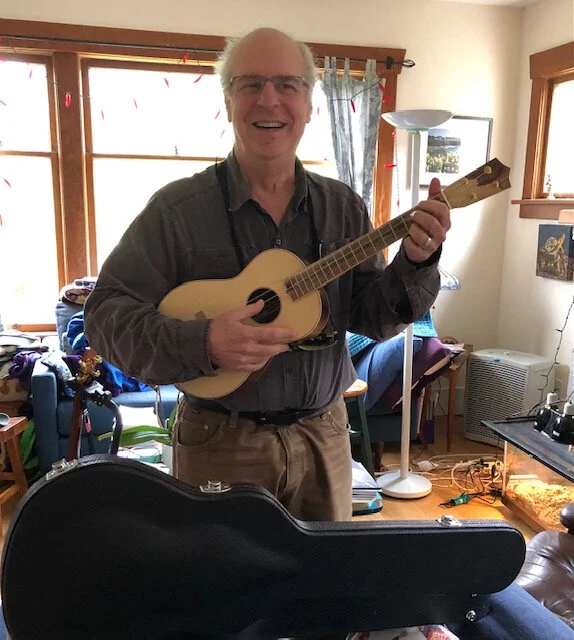
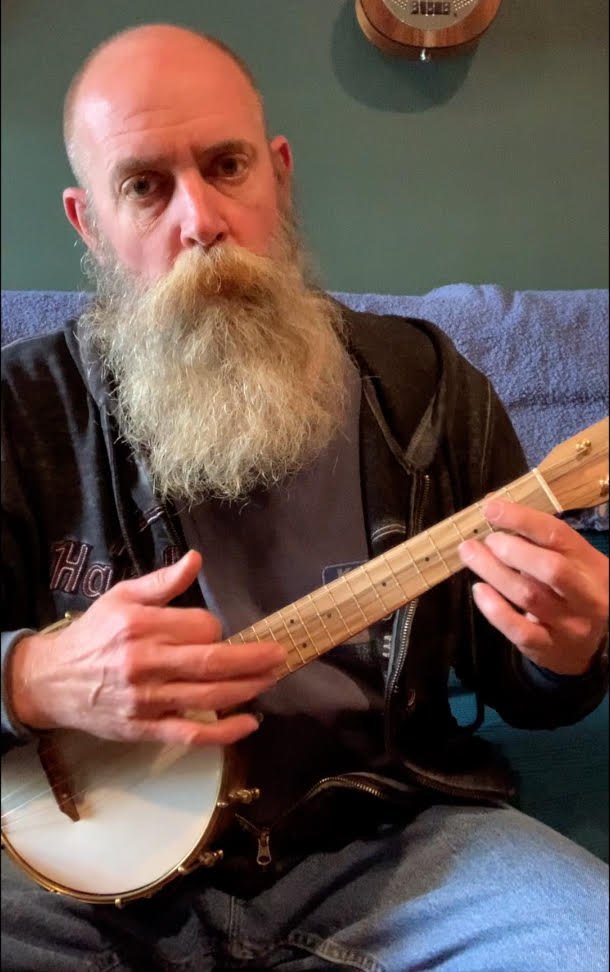
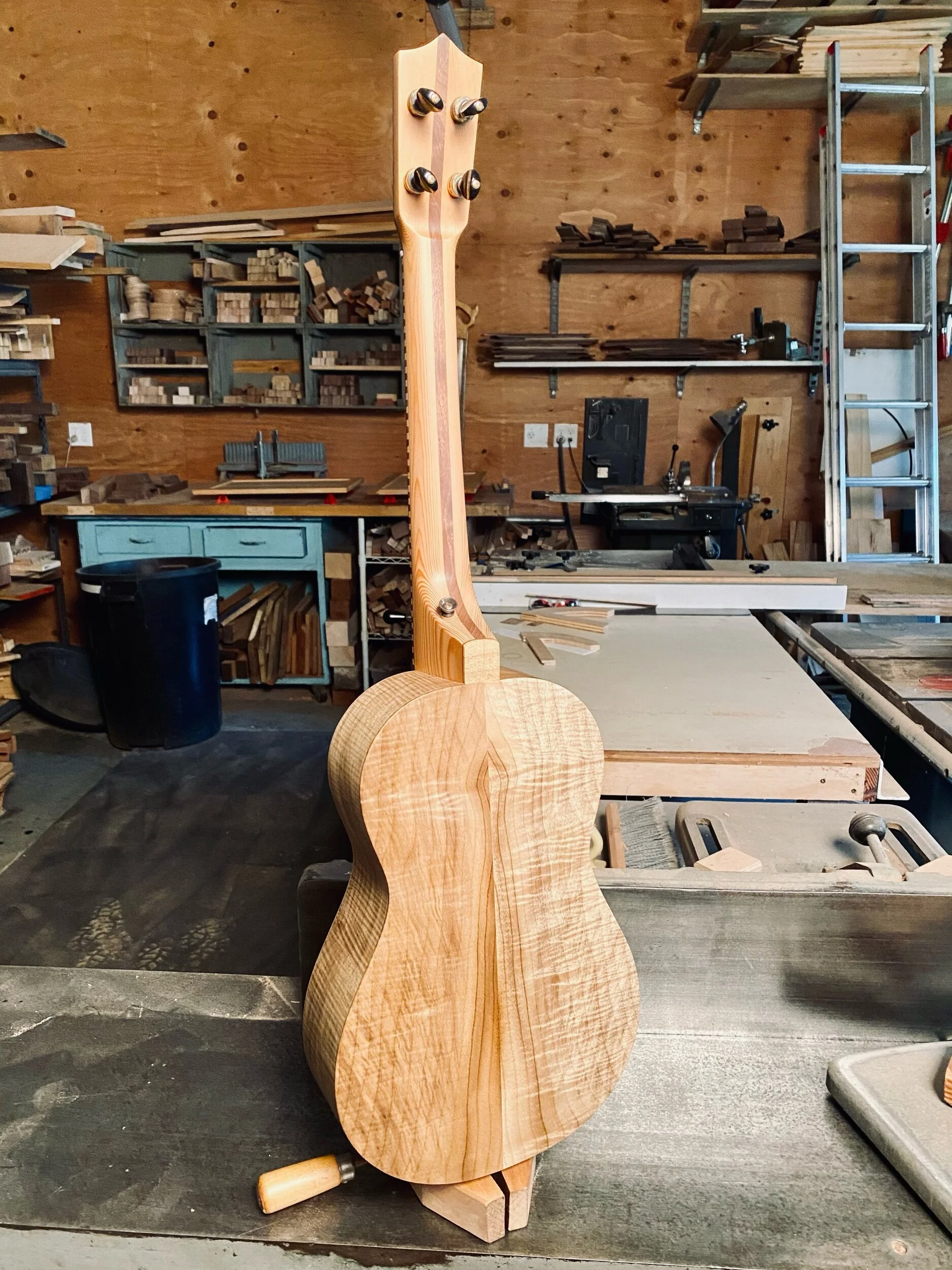
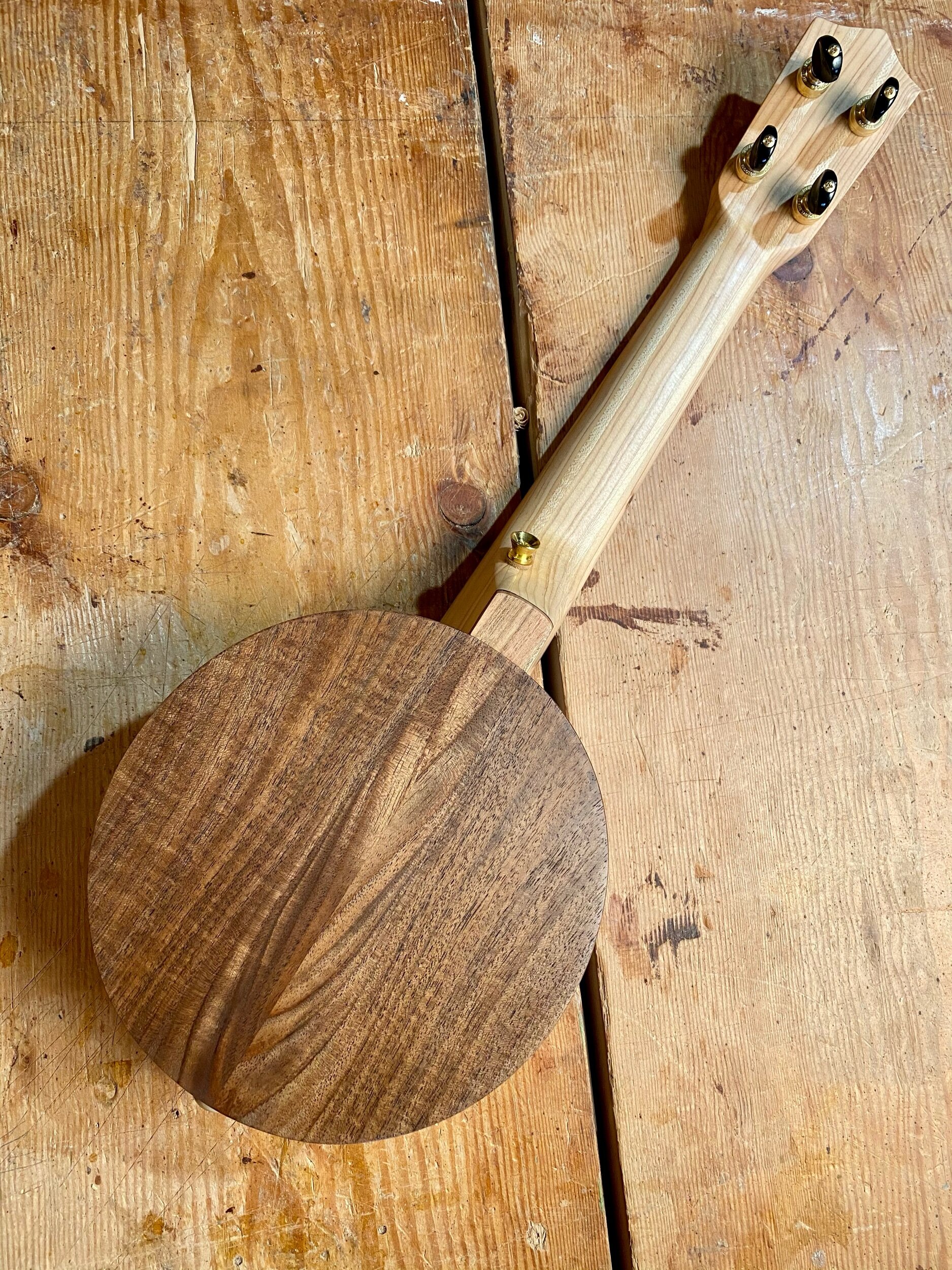
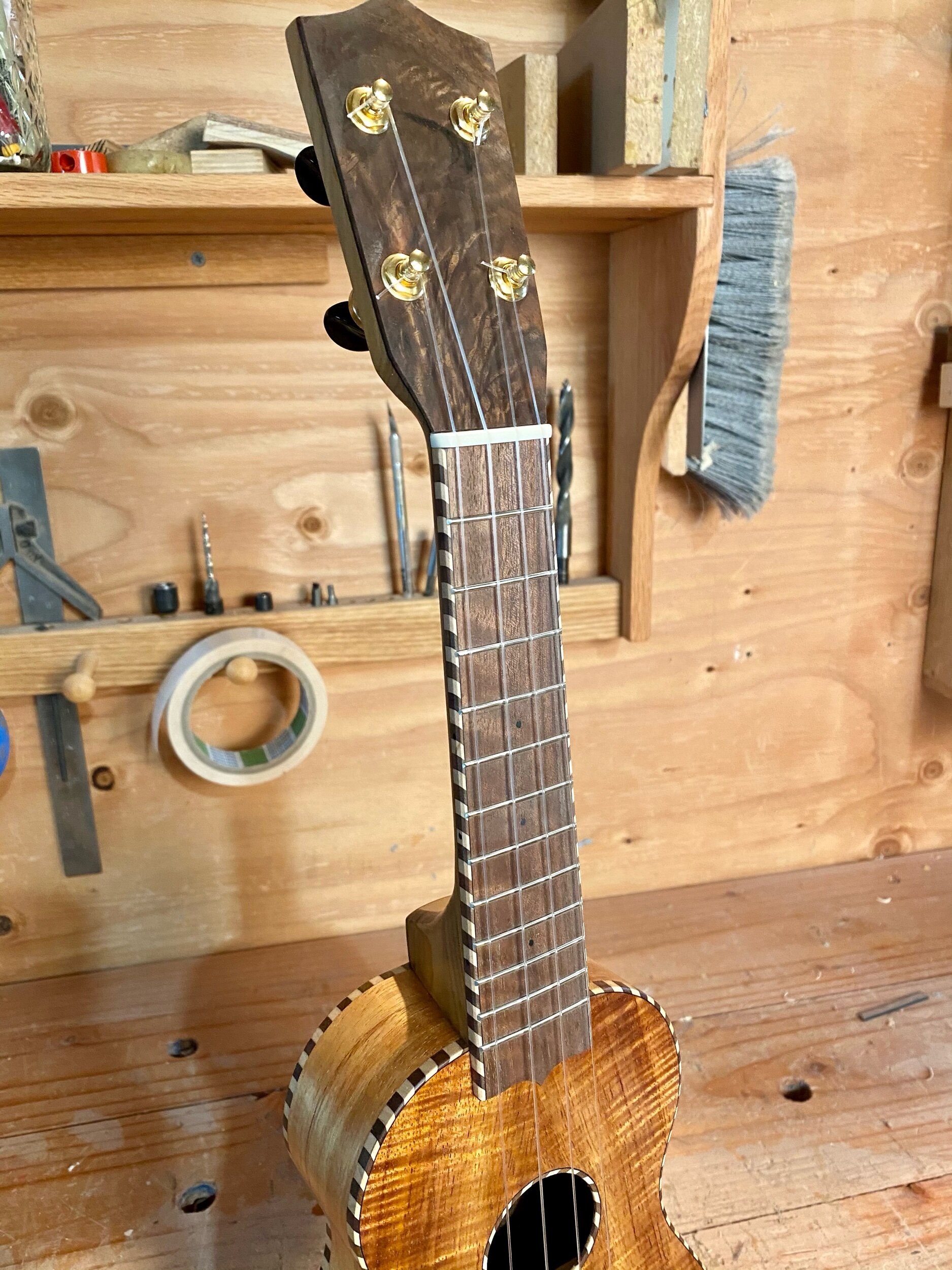
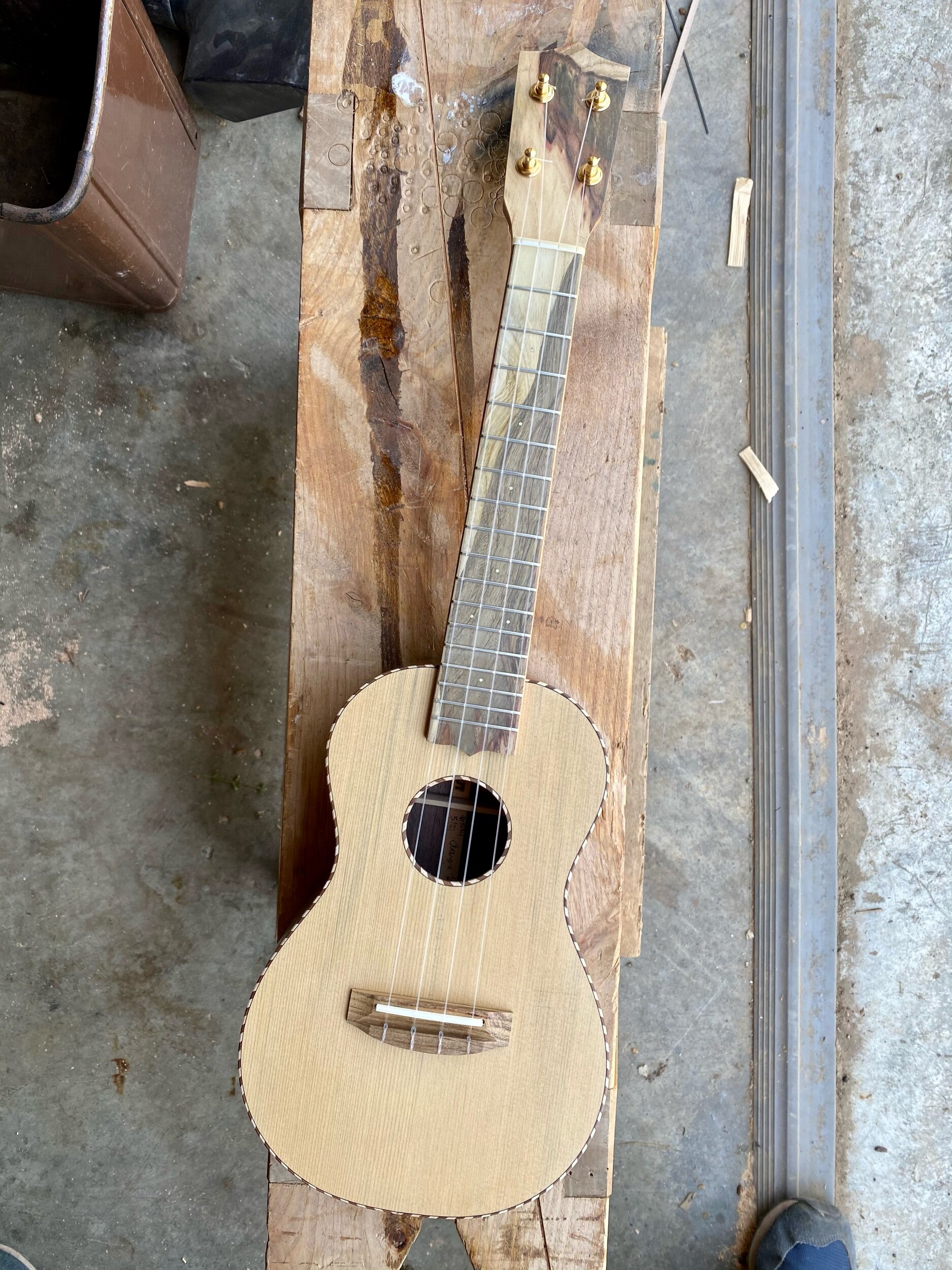
Even though this one has some of my most popular woods, the customer’s small requests made for a unique and special instrument. I’ve had a great time playing it the last couple of days too, easy action, a sweet tone and plenty of volume. The old growth Port Orford cedar top from the Oregon coast is stained with natural blue mineral stains or spalting. I love its subtle texture and look. The striped Oregon walnut back and sides is from the shorts bin at Goby in Portland. The pistachio has a really unique look, from California orchards. Lastly, the old growth for neck was salvaged from a floor joist. The brass fret dots and rope binding add some nice detail to complete the look.
To Aaron, Nicole and the Inestimable Henry,
Heartfelt gratitude, belated and ongoing, for my beautiful Alto- #594. A few months into Life-ing with this ukulele, I am more thrilled than ever: your outlook, artistry and skill have resulted in an instrument that is bringing me joy on so many different levels.
I love all the stories in the wood, and look forward to all the new stories yet to be told: reclamation, grace, and some good ol’ punch. For the work of your hearts and your hands, and for #594: Thank you!
My best to you and yours,
- S. S.
— Quote Source

#578- Builder’s Choice- Douglas Fir Firewood Baritone Ukulele

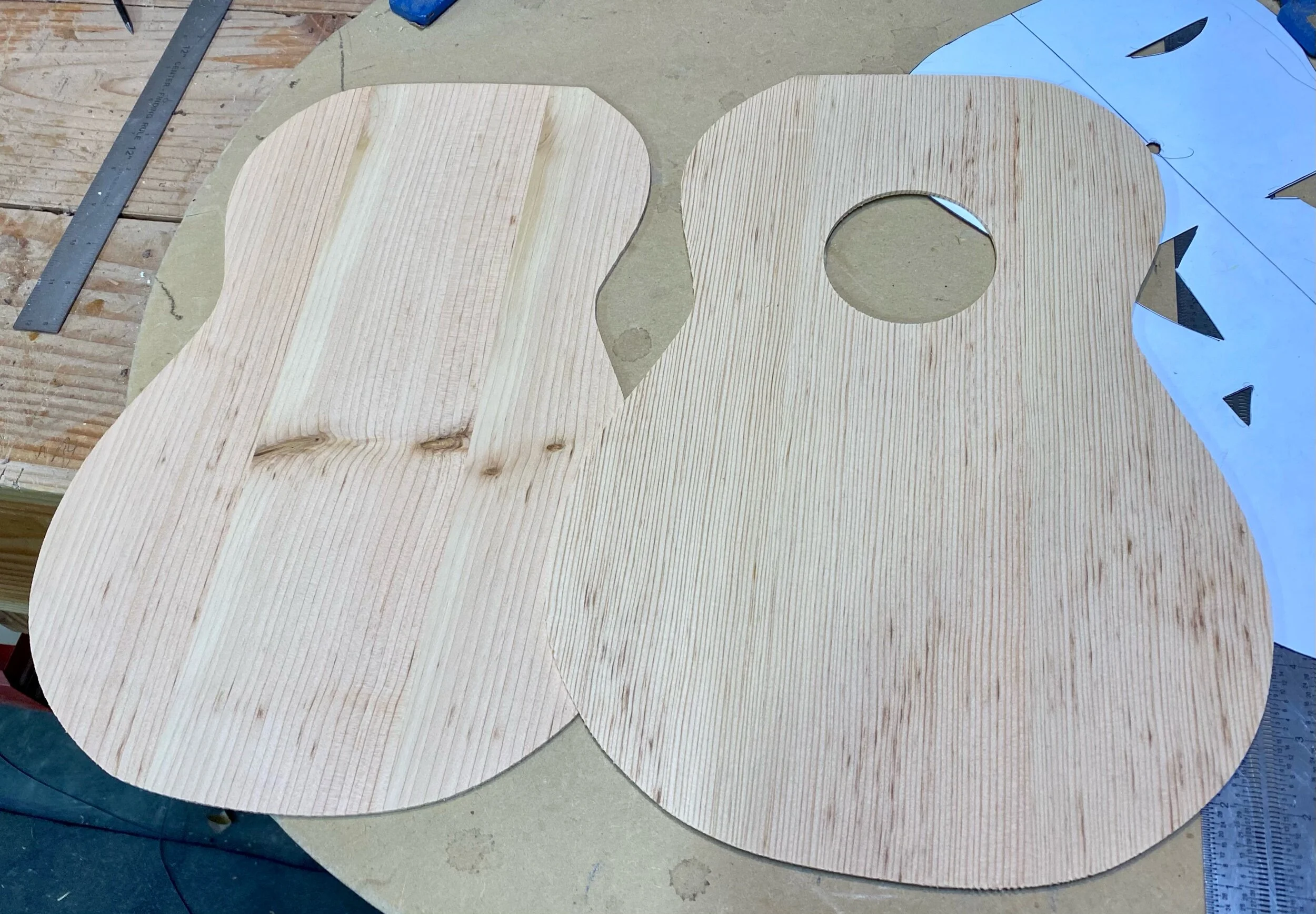
This project started last fall when I bought a pallet of firewood off Craigslist. It was mostly scraps from a farm sawmill and I decided to keep a few for projects. I stacked them in the shop to dry out for a few months before starting on a uke. As you know, I regularly use fir for ukes, but it’s mainly old growth salvaged wood, which has a fine grain to it and is very strong and light. This second growth wood is a little heavier and wider grained. I thought it would be a fun experiment. After all, if I don’t like it I can just burn it! I used walnut for binding and neck stripe and maple for fretboard, headplate and bridge. The fretboard is also an experiment for me, as it was stabilized with resin to make it harder and stiffer, which I think is a good move. I got it from woodfromthewest.com.

I like the sound a feel of this uke a lot. The whole thing hums and vibrates with a mid range intensity that I like. Sort of like a flamenco guitar vs a concert grade classical guitar. I plan on keeping this for myself, unless one of you swoops in. After all, I’ve got more firewood!

See below for an extra gallery of in process photos.

#584- Spruce and Grafted Walnut Baritone Ukulele

Spruce and walnut baritones have become pretty popular around here lately, and it’s easy to see/hear why. This one is plenty loud but has a rich and smooth tone as well. The Engelmann spruce top is from a retired guitar builder. The grafted walnut back and sides and the grafted pistachio fretboard and headplate come from California orchards. The fir neck is salvaged from a floor joist.

tom.jpg

#587- Redwood and Curly Myrtle Scout Ukulele

Today I offer you another member of the Scout ukulele family: rustic, handmade and one of a kind. This one has a redwood top that I got from Jayson Bowerman, a luthier from Bend, OR. The Myrtle back and sides and the mahogany neck are made from scraps from other ukuleles. The fretboard, headplate and bridge are Jatoba or Brazilian cherry, a very dense hardwood that I salvaged from the Carpenter Ant stash in Portland. This one has a really nice tone, due to the redwood top, I imagine.

“I am so happy I asked to be added to the Scout waiting list! I was hesitant since I knew I would have no choice in the woods used to make the ukulele, but I decided there was little risk after I viewed the completed Scout ukes in the gallery and saw they were all beautiful and sounded fantastic. I own other Beansprouts and have always enjoyed following the progress of my instrument build on social media and was afraid I would miss out on that with a Scout. However it turns out the Scout experience is exciting in its own way! It was fun to see the photos of Scout builds in progress posted to social media and to watch the completed work demo videos and to wonder if that was going to be MY Scout. When I saw the video for this one, I was blown away by how awesome it was and simultaneously disappointed it wasn’t mine since I had not been contacted about it. However, a few hours later I was elated when I received an email from Nicole offering that very Scout uke to me! I had not set my heart on any particular wood combination, but I could not have chosen a better combination if I tried. This is the perfect Scout for me! Aaron often speaks about the concepts of wabi sabi and acceptance and how they are guiding principles in his work. I feel like the process of getting a Scout uke exemplifies these principles and of the Beansprout brand overall. Of course there are no flaws in this ukulele to accept, so I mean that from the perspective of accepting that I did not choose the woods or the build date. By placing my trust entirely in Aaron’s artistic eye and skillful hands and allowing fate to flow I ended up with my dream Scout uke. This ukulele and the experience of getting it is a good reminder to me that sometimes it is best to get out of my own way and see what beautiful things come to me as a result. Thank you for the fantastic ukulele! I always feel so lucky to receive a Beansprout instrument and to feel like I have a tiny part in the Beansprout family.”
- J. L.
jennifer.jpg

#585- Port Orford Cedar and Myrtle Alto Ukulele

This instrument was ordered by a customer who already has several nice ukes, including some traditional Koa ukuleles made by Hawaiian makers. He said he wanted something different and he got it! The rich earth tones, asymmetrical figure and small wabi-sabi surprises certainly make it unique. The port orford cedar is from the Oregon coast and the pistachio is from California orchards, via woodfromthewest.com. The myrtle is from the same board as Nicole’s ukulele, discovered by us at a roadside stand in Manzanita. The fir is from a salvaged floor joist. It really has a sweet voice that only needs a gentle touch to speak out. I’m quite pleased with it.

Beansprout 585 is beautifully built. I’m tempted to hang it on the wall as a piece of folk art (not to worry Aaron, I keep it in the case!). I do not regret taking the “plunge” into a little wabi-sabi. The one-piece, asymmetric wood was a “first” for me, and it looks great. Aaron’s choice of a walnut bridge and binding was excellent and ties everything together. It definitely looks different from my other ukes! Aaron mentioned in his video that the uke has an “earth tone vibe” and I agree. For me, it is classic Pacific Northwest. It looks like an instrument with an old soul and stories to tell. It’s very cool to know there is not another one like it in the whole world.
The sound of the instrument is definitely different from my traditional ukuleles, which is what I wanted. At first, it was hard for my ear to “place” the sound - definitely ukulele, but also “dirtier” or “smoky”... with some guitar thrown in. The tone of the uke has “opened up” with time, too. It is a unique voice in my ukulele collection. Intonation is great all the way up the neck. I find the instrument especially sings when I am picking, which makes me wish I was a better picker (on my “to do” list!).

Thanks again for checking in with me and for making such a beautiful instrument.

Best wishes,
- F. Q.

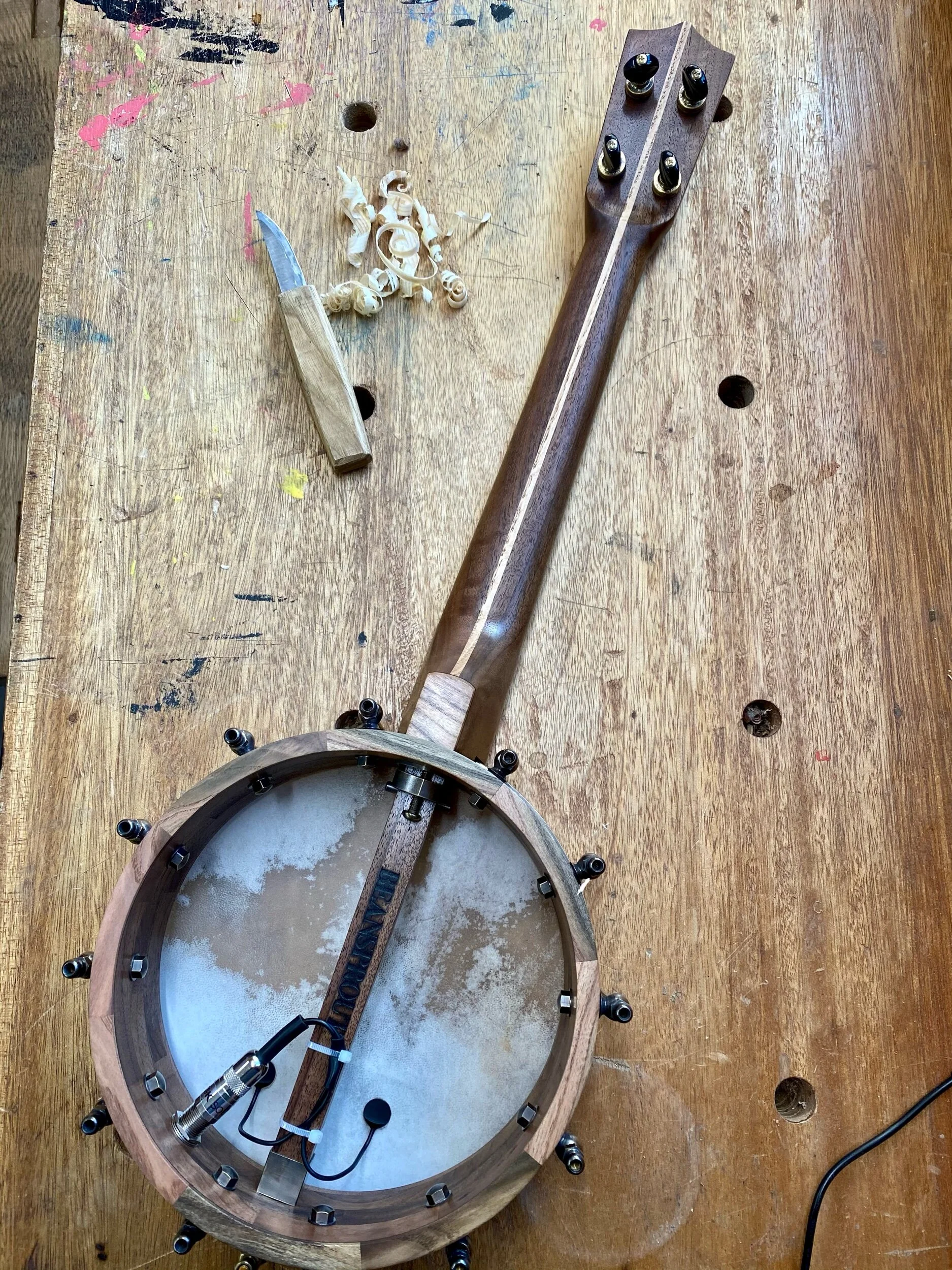
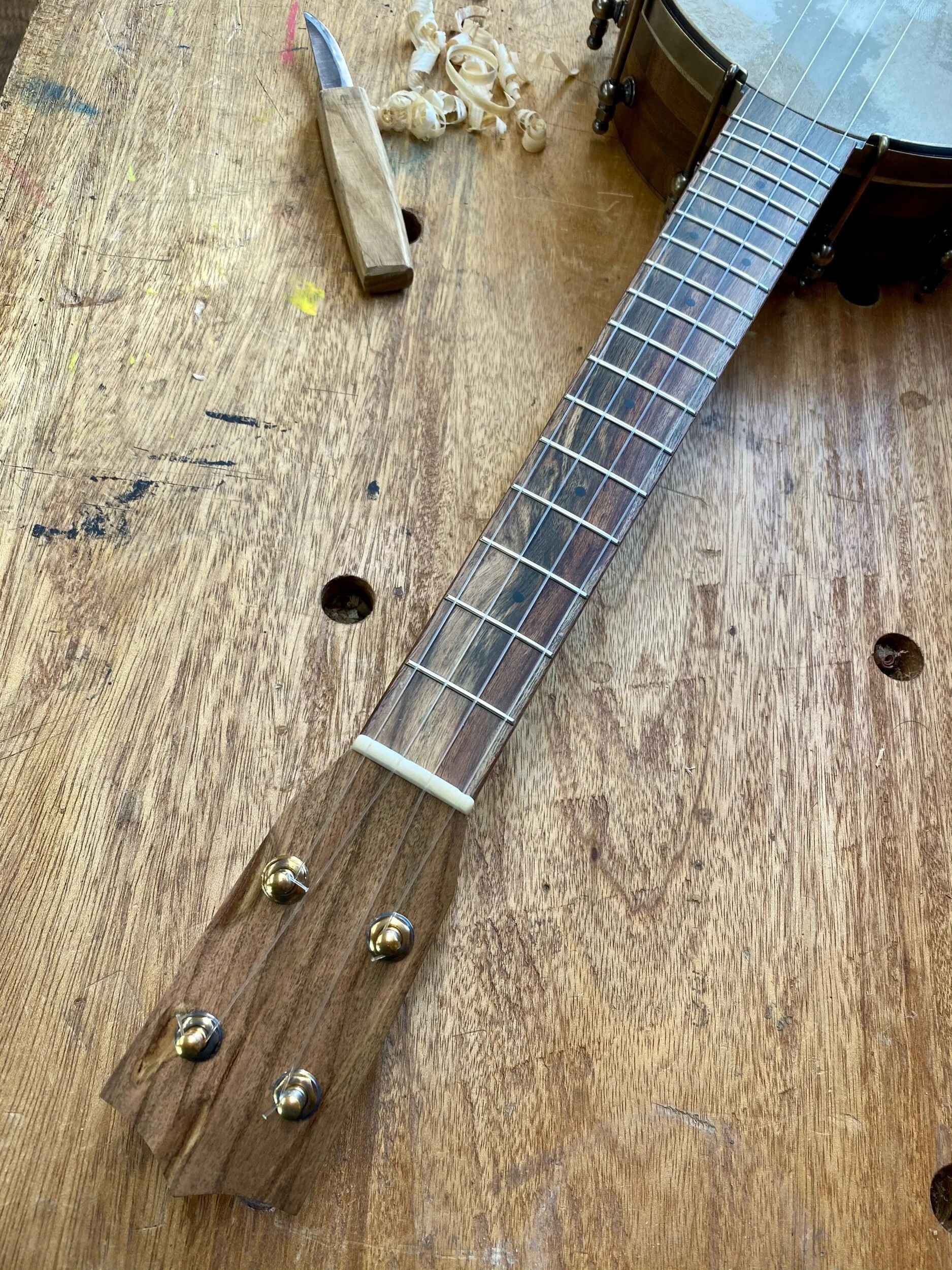
#586- Figured Walnut and Pistachio Tenor Banjo Ukulele

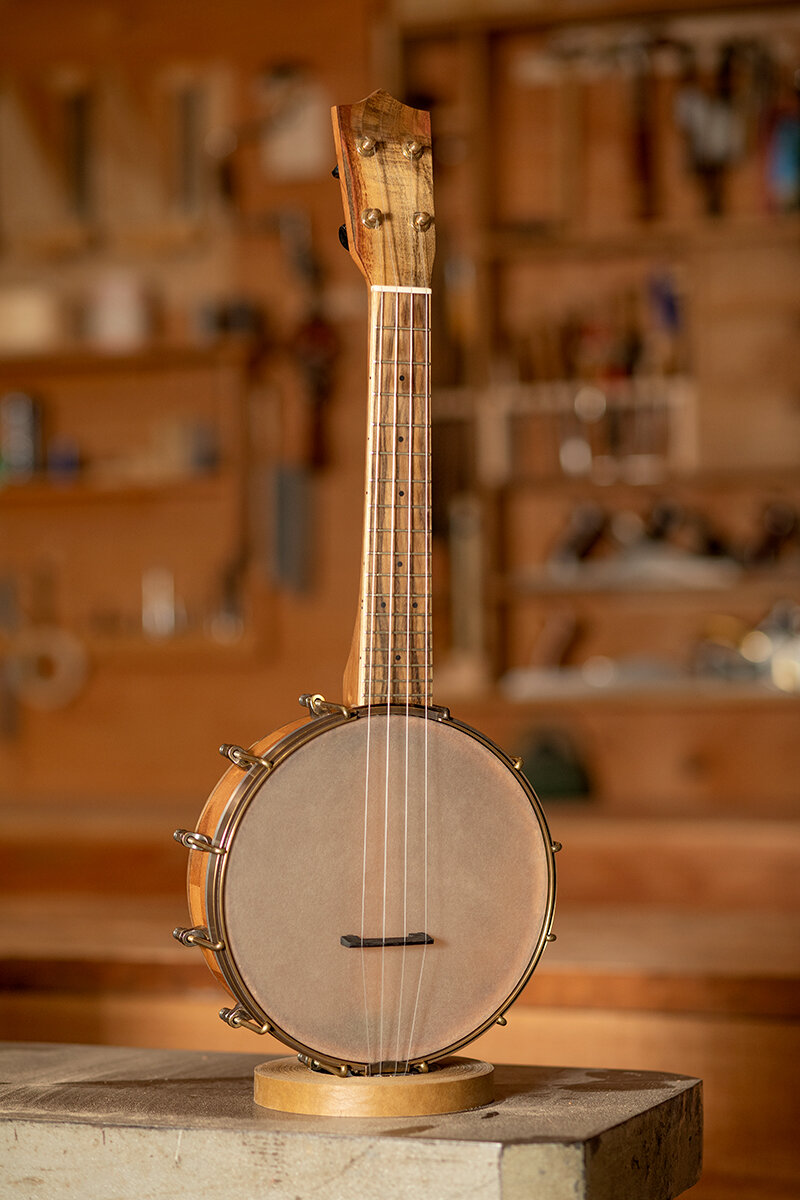
It still amazes me after all this time that each instrument comes out looking, sounding and feeling unique. They really all do have their own personalities, which really keeps it fun for me. The combination of walnut, goat skin and a low fourth string really makes this one rich and dark but plenty loud. Really fun to play. The walnut is from Edensaw in Port Townsend, WA and the pistachio is from California Orchards.

I really love the instrument - the setup is so nice I’m able to play some of the more challenging (for me) chords successfully. I like the sound variations you can get - playing over the head has a very banjo sound, but playing over the fretboard reduces that quite a bit. It also looks great - the walnut is beautiful and I really like the pistachio as well - the contrast between the two is really nice. I also really like the way the discoloration in the goat skin worked out as it lends an “antique” sort of look to the instrument.
-E. S.

#581- Curly Port Orford Cedar and Curly Myrtle Baritone Ukulele

When Ian selected the wood for this instrument, I was struck by the muted color pallet and earth tone vibe. Without any binding or purfling, it really shows off the wood grain. I doubled down on this look by using walnut veneers instead of black and by darkening the brass hardware. The flash of rope binding on the fretboard is all it needs. All the wood, except for the salvaged fir neck, is from woodfromthewest.com.

#580- Port Orford Cedar and Quilted Maple Alto Ukulele

This one is all about balance: the robust Port Orford cedar balanced by brilliant maple, the asymmetrical top and back balanced by straight grain hemlock and pistachio and the light colored woods wrapped in dark walnut binding. Also, the best bug hole ever was revealed in the hemlock neck when I sawed into it. I love it so much, I had to feature it. The maple and hemlock are from the Carpenter Ant stash in Portland and the Port Orford cedar and pistachio are from woodfromthewest.com.

Hi Aaron & Nicole,

Thanks for checking in. The Alto, for me, is really in that Goldilocks zone of being just right for every situation. It is light, easy to play and is LOUD. It sounds great strummed or finger picked. Maybe its recency bias, but I think its my favorite of the three Beansprout Ukes I have so far!

Looking forward to seeing what you cook up with the
5-string Banjo this fall!
- J. P.

#582 and #583: A matched pair of Walnut and Pistachio Banjos

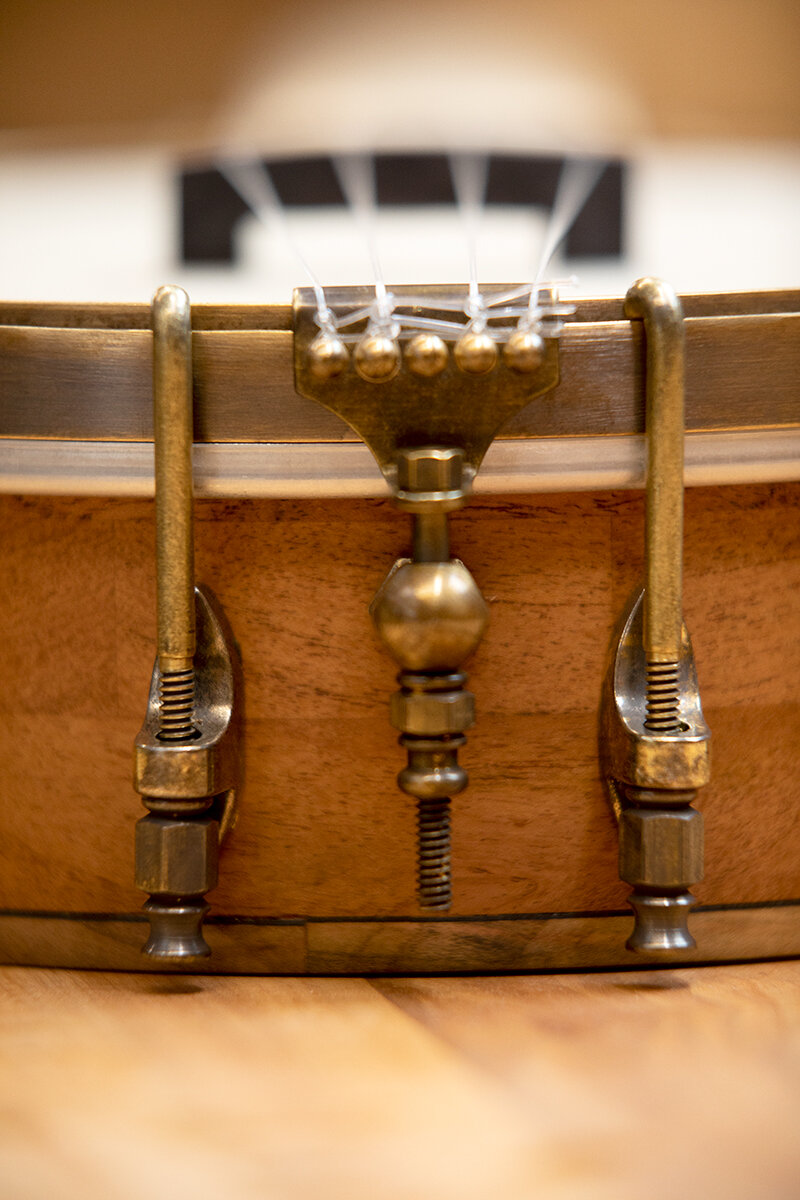
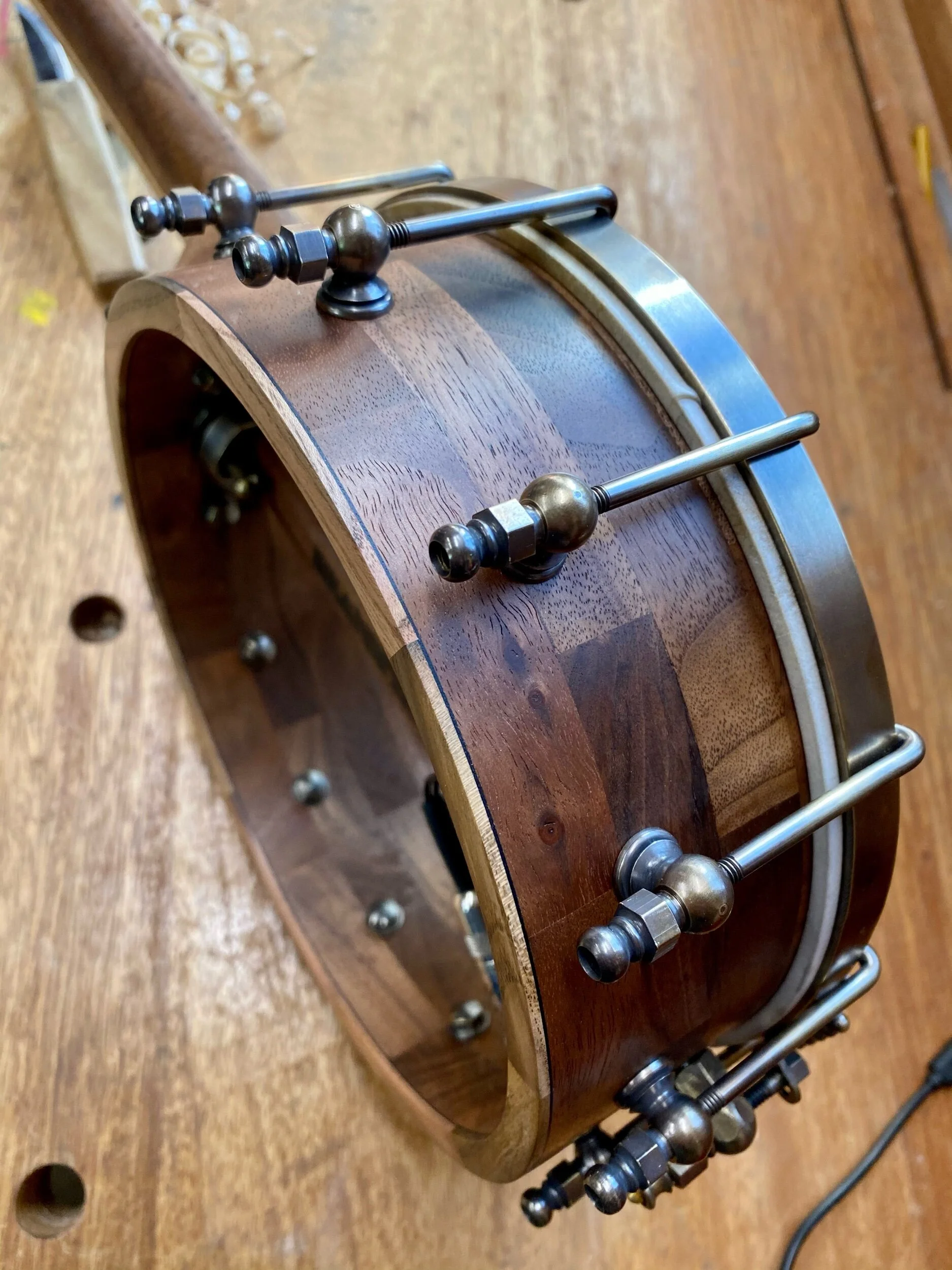
Working on a pair of instruments offers an extra set of challenges into the shop schedule. As I work on an instrument, I often let the wood, the shop flow and any happy accidents steer me to make design decisions along the way. But with two instruments, I had to keep it really tight and make sure they truly belonged together. This set also included a few small design requests from the customer: brass fret dots, raw brass and cream tuners and translucent goat skin heads. I chose old, air dried black walnut from Vashon Island for the bodies and Pistachio from California orchards for the rest. I made the brass tension hoops and my friend Brooks Masten made the rest of the hardware. The big four string banjo is 11” rim and 20” scale, tuned dGbd. The concert banjo uke is an 8” rim and 14.7” scale, tuned gCea.

Aaron and Nicole,

I am so pleased with the pair of banjos. I have been following your work for many years. The quality has always been apparent through your videos, but holding them in my hands has really exceeded my expectations. The aesthetics, tone, and playability are excellent. I look forward to using them on many projects ahead.

Thank you for your passion in creating these instruments. I always look forward to seeing what you create.

Have a great day,
- C. P.

#579- Spruce and Walnut Scout Ukulele

A small but challenging project for me, I love building these Scout ukuleles. I’m often surprised by how big the sound is for such a small uke. Oregon spruce top, curly walnut back and sides, hemlock neck and pistachio fretboard/headplate/bridge. All the wood are shop scraps and cut offs from other projects.

#575- Port Orford Cedar and Curly Walnut Alto Ukulele

This instrument just feels like spring to me. The smell of dirt, the bite of the last frost, the struggle to sprout, the feel of compost in my hands, the promise of a new thing grown from last years refuse. It sounds/looks funky, rich and sunshine bright, all at the same time. I’ve had a hard winter and sometimes it’s been hard to keep the pace I’ve set for myself. This one helped me transition to spring and the chance to make a few small changes for the better.

The Port Orford Cedar top is from the Oregon coast and has some dark mineral staining from its years sitting as a stump before it was salvaged. The curly walnut back and sides are from Goby Walnut in Portland. The fir neck is a salvaged floor joist. The pistachio fretboard, headplate and bridge are from California Orchards.

Aaron and family,
I’ve been playing #575 for a few days now. It is stunningly beautiful. I feel very privileged because you made me the most beautiful instrument in your entire gallery. I’d bet that most of your customers feel that way about their own instruments!

When I first played it, I thought it sounded quiet and a little thin. In the days since, it seems like I can hear a change in tone and resonance. I’m not sure if it’s the wood settling or the strings stretching or my playing technique. I suspect it could be all of the above. This feels like an instrument that will change and grow with me as we get to know each other.

Each time I play it I find a new detail to admire. I especially appreciate how the neck is tapered at the fingers and more square for the thumb. It is very comfortable to hold and play.

Your instructional videos and instrument demos on YouTube have been a daily part of my life for years now. I really loved the personalized video you made for #575. I must have watched it 10 times!

Thank you for the beautiful and unique ukulele.
- J. H.
— Quote Source

#573- Spruce and Curly Walnut Alto Ukulele

This is my first time using Engelmann spruce instead of Sitka. Engelmann is an inland alpine species and the best boards have this tight grain and tiny ray figure in it. I think it has a big, cheerful voice and look forward to using it more. I got a stack of it from another luthier, Jayson Bowerman, so stay tuned for more ukes with these tops. The back and sides are curly Claro walnut salvaged from a gunstock blank. The neck is hemlock and walnut left over from the yurt we built in the back yard. The pistachio fretboard, headplate and bridge are from California orchards. Over all, this is a simple build with some beautiful wood grains, easy playability and good dynamic range. I’m very happy with it.

It is a joy to play an ukulele built especially for me! Part of the experience was having updates on the build with pictures and hearing stories of where and how the wood was acquired. And I love showing the YouTube of “Completed work #573” to my friends. I asked Aaron for a spruce top with curly walnut back and sides, and a pistachio fretboard with green stripes and he found the perfect, most beautiful pieces of wood. This instrument plays so easily and sounds bright and full. I cannot stop playing it! It is truly an exquisite piece of artwork! Thank you!
- K. B.
kim.jpg

#577- Curly Walnut and Pistachio Tenor Banjo Ukulele

The combination of goat skin, dark brass hardware and curly walnut really worked out well on this one. The customer asked for a fretboard that looked like his view of a mountain range and a goat skin that resembled a full moon, which was a little challenging but turned out great! The pistachio is from California orchards and the walnut is urban salvage from Goby in Portland.

I love it!!

It came out better than what I envisioned and it sounds amazing. I really don’t think I could have asked for anything more.

Thanks again for all your hardworking and your amazing craftsmanship I really appreciate it and look forward to ordering from Beansprout again in the future.
- C. C.
— Quote Source

#572- Curly Port Orford Cedar and Mastergrade Myrtle Tenor Ukulele

This ukulele is for my friend Chris Dean, a talented teacher, musician and banjo builder who lives in Seattle. We chose curly Port Orford Cedar and Mastergrade Myrtle for a balanced tone and to focus on wood from the NW. The walnut neck and knitting needle fret markers are a nod to Chris’ instruments and the instruments of WV builder Jenes Cottrell, who is an influence on Chris’ work. It is a visually stunning uke, is easy to play and has a vibrant, balanced sound. I am excited to get it to him and see what he comes up with! The cedar and myrtle are from the Oregon coast and the pistachio is from California orchards, all courtesy of woodfromthewest.com. The walnut is urban salvage from Goby in Portland.

#571- Bearclaw Spruce and Spalted Maple Baritone Ukulele

I find that some of my best instruments are the ones where I take the wood’s natural tonal characteristics and find a way to enhance them, but not take it too far. In this case, I knew that spruce and maple will be naturally bright, which is good, but I also want to brace and carve the top so that it is still rich and warm. This time it really worked out! The Bearclaw figure spruce is old growth salvage from Alaska, the Spalted maple back and sides are from the Carpenter Ant stash in Portland, the fir neck is salvaged from a floor joist and the Pistachio is from California orchards.

Dear Keim family,
This is just a quick note to let you know that #571 arrived safely, I’ve been playing it all day, and I’m very pleased. The sound is lovely and the craftsmanship is all I hoped for. I’m most impressed with the unique signature that you’ve brought to the design of your instruments - holding one just feels distinctive and special. I recently moved to the east coast after 20 years in the Pacific Northwest. This instrument exudes the woodsy flavor of the PNW that I fell in love with all those years ago. Thanks to you I’ll have a daily reminder of those days. Thank you!
- D. W.

#576- Walnut and Pistachio Concert Banjo Ukulele

Walnut and pistachio is a customer favorite and it’s not hard to see why. The variable look of the pistachio and the deep, rich walnut color always pair well together. In this case, the un-plated brass and natural goat skin add to the look. The sound is a winner too, balanced and rich with a loud voice. The walnut for this build came from my friend Cath’s shop on Vashon Island and the pistachio is from California orchards.

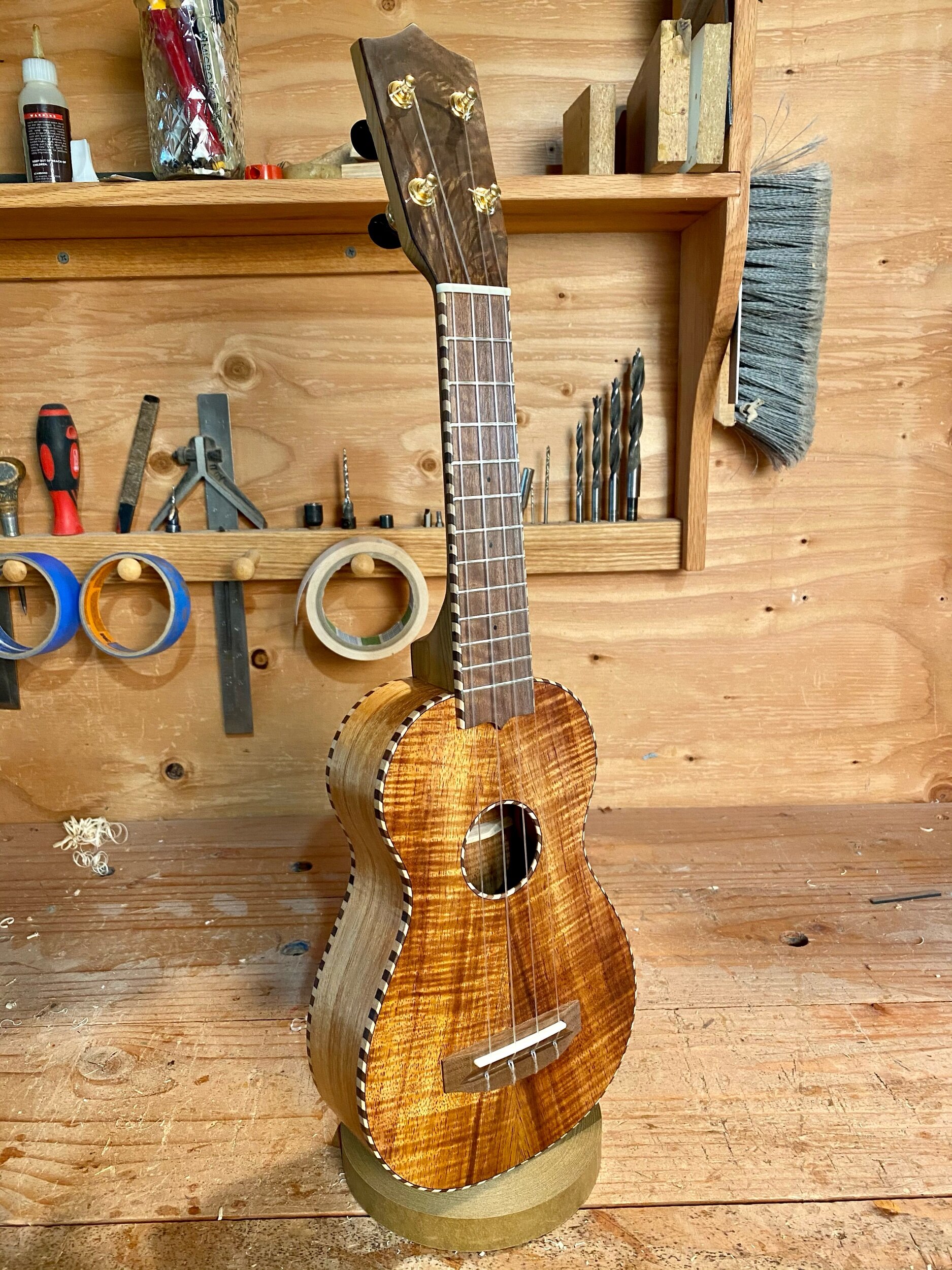
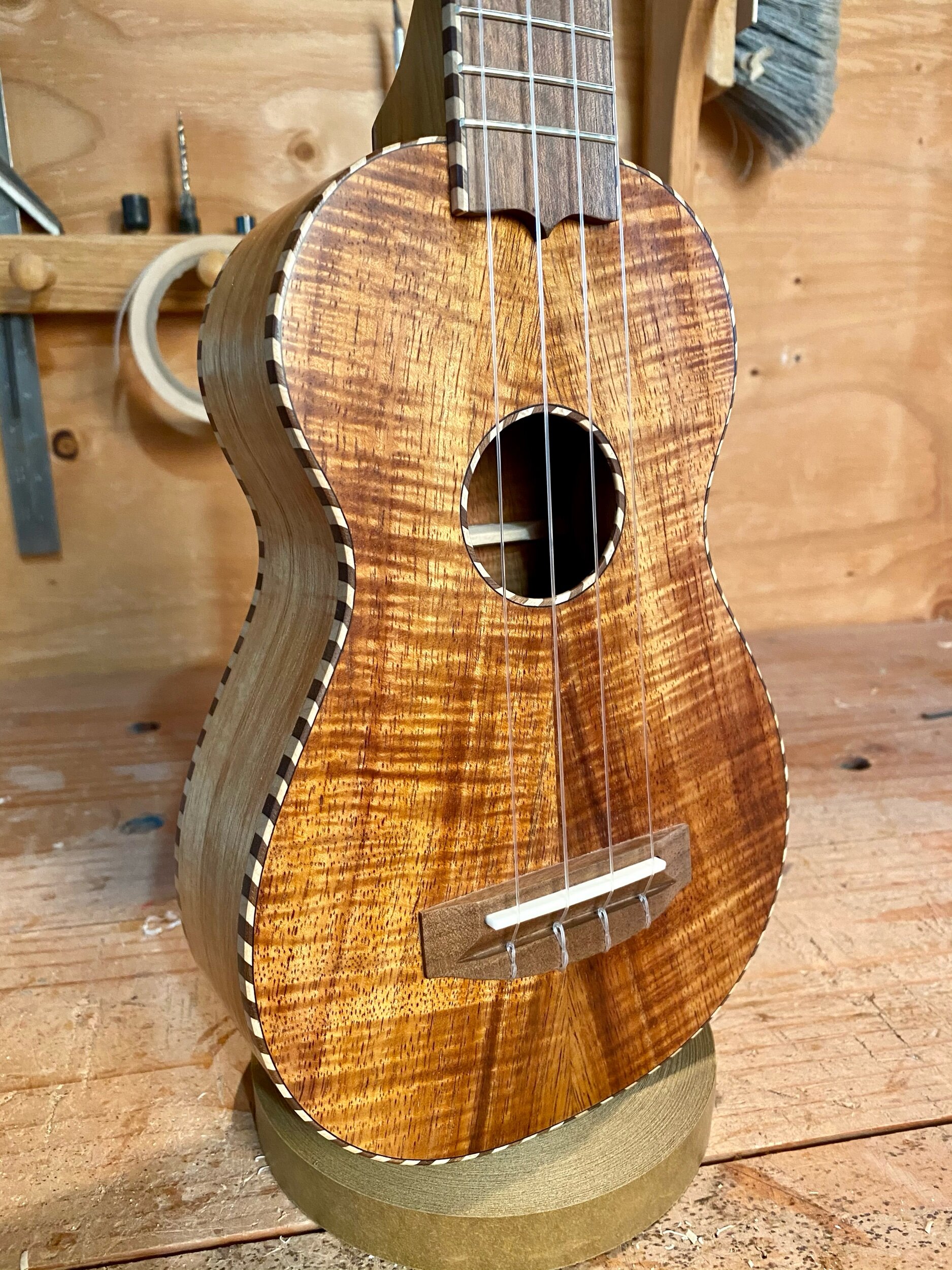
#570- Curly Koa Soprano Ukulele

This is the first of our new soprano ukuleles built for a customer. I am inspired by classic instruments from the early 20th century and this one strikes a good balance for me between old and new. I still want modern playability and a balanced tone, but I like the special sparkle of the older ukes. I also think this one strikes the right balance between classic elegance and handmade folk art, just like the older instruments did.

I inherited the curly Koa from Char when she retired from Mya-Moe, the walnut is urban salvage from Goby in Portland and the fir and cedar for the neck are from the carpenter ant stash.

#574- Curly Maple and Pistachio Concert Banjo Ukulele

After all these years building banjo ukes, you would think I can predict everything about how an instrument will turn out. Yes, I know that maple will be plenty loud, but I was shocked by how sweet this one is! That’s just the perfect word for its tone and playability: sweet.

The beautiful curly maple is from the Carpenter Ant stash in Portland, originally cut for grandfather clock cases. The pistachio is sustainably harvested from California orchards.

Hello, Aaron, Nicole & Henry!
The stunningly beautiful Curly Maple & Pistachio Concert Banjo Uke #574 that Aaron made for me, arrived this morning. Thank you so very much! I will enjoy getting to know my “Strad” and you can be sure, despite the fact that I have promised he can rent it, my husband is quite jealous!
- S.S.

#538- Mesquite, Cherry and Pistachio Concert Banjo Ukulele

Every couple of years, I sell my instruments and build new ones. It allows me to keep the current designs in my hands and on stage so I can get honest feedback. For this instrument, I am trying out a new wood for the rim: mesquite. I recently bought out the stock of rim and neck material from a retiring luthier. It features a lot of this North American wood, normally found in desert climates. I thought I should try it out before offering it to customers. I paired it with a cherry and pistachio neck, dark brass hardware and an ebonized oak bridge. Overall, a striking instrument that is easy to play and sounds good. Maybe we will even get to play concerts this year!

#553- Builder's Choice: Red Cedar and Curly Walnut Alto Ukulele

This is the first in my Builder’s Choice series, where I give myself the space to try new things and build as I please. Hopefully it will also produce instruments that find a home with the perfect player/owner. The cedar for this was harvested near Bend, OR by luthier Jayson Bowerman. It is some of the stiffest cedar I have ever used and behaves more like spruce, in my opinion. The curly walnut also comes from Jayson as the pieces are too small for his guitars. I bound it with maple binding and some beautiful hombre purfling, with multiple brown shades in it. The curly walnut fretboard, headplate, bridge and pickguard are from the scrap bin at Goby Walnut in Portland. The old growth fir neck is from a salvaged floor joist. It sounds sweet but serious and is a joy to play.

Thanks Nicole and Aaron,
I am throughly enjoying the Builder’s Choice. It reminds me of the Oregon I knew decades ago. I am not trained musician, and I just go by the sound of the instrument. The “Red” plays beautifully to me. Enjoying the smell of the wood when I bring Red out to play too.

I hope Aaron gets inspired again by a new wood find, or combination of old growth, old stash, and new ideas.
Best to you all
- A. F.
aileen.jpeg